Modern enterprises face a widening productivity paradox. As business cycles accelerate, employees have less time than ever for skill acquisition. The traditional L&D model, requiring deskless staff or busy managers to sit through 60-minute slide lectures or multi-hour e-learning marathons, consistently leads to cognitive fatigue, disengagement, and the rapid decay of critical knowledge.
To solve this operational friction, leading organizations are actively pivoting to corporate training microlearning solutions.
By dismantling dense training manuals into targeted, bite-sized learning nuggets delivered directly within the flow of work, enterprises achieve up to 80% higher completion rates and substantial improvements in on-the-job capability retention.
This comprehensive guide breaks down how enterprise L&D leaders can deploy high-impact microlearning in corporate training, evaluate modern delivery platforms, and integrate microlearning into broader workforce development frameworks across India, the UAE, and global operating hubs.
Quick Summary: What Are Corporate Training Microlearning Solutions?
Direct Definition: Corporate training microlearning solutions are structured learning methodologies and technological platforms designed to deliver focused, bite-sized instructional content, typically lasting 2 to 7 minutes, targeting a single learning objective. Unlike passive long-form courses, these solutions use interactive media, branching scenario simulations, and spaced repetition to provide just-in-time knowledge that employees can immediately apply on the job.
Why Long-Form Corporate Training Fails Modern Teams
The human brain is biologically ill-equipped to absorb massive information dumps. The Ebbinghaus Forgetting Curve demonstrates that without immediate reinforcement, humans forget approximately 70% of newly acquired information within 24 hours, and nearly 90% within 30 days.
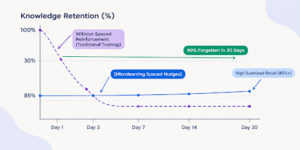
Deploying microlearning solutions for corporate training counters this decay curve directly. By distributing knowledge into frequent, spaced micro-interactions, organizations reinforce memory pathways, shorten time-to-proficiency, and eliminate workflow disruption.
Traditional Corporate Training vs. Enterprise Microlearning Solutions
Transitioning to modern learning formats requires understanding the operational shift between traditional LMS courseware and modular micro-content:
| Operational Dimension | Traditional Corporate Training | Enterprise Microlearning Solutions |
| Duration per Module | 45 to 90 minutes per session | 2 to 5 minutes per focused nugget |
| Learning Objective | Covers broad, multifaceted topics simultaneously | Targets one discrete skill, task, or concept per module |
| Delivery Medium | Desktop LMS or mandatory physical classrooms | Mobile-first apps, web nudges, and QR code access |
| Workflow Impact | Pulls employees away from active duties; causes downtime | Consumed during natural shift transitions or floor lulls |
| Completion Rates | Averages 20% to 30% across voluntary courses | Consistently exceeds 80% to 90% across distributed teams |
| Development & Update Cycle | 3 to 6 months to revise dense courseware | Updated and deployed within hours to reflect market shifts |
| Cost & Operational Overhead | High logistical, trainer, and classroom travel costs | Highly scalable, low delivery cost per active learner |
Strategic Use Cases: Microlearning Across Enterprise Functions
Microlearning is not a one-size-fits-all format. High-performing organizations customize their microlearning for employee training by tailoring delivery to specific departmental workflows:
1. B2B Sales Enablement & Revenue Operations
Sales professionals cannot afford to spend hours in training when deals are on the line.
- Application: 90-second product comparison breakdowns, conversational objection-handling audio snippets, and competitive battle cards accessible via mobile minutes before client meetings.
- Impact: Accelerated ramp-up time for new business reps and immediate lift in Average Transaction Value.
2. Mandatory Statutory Compliance (POSH, DPDP, AML)
Compliance training suffers from notorious click-through disengagement.
- Application: Scenario-based branching dilemmas rather than 50-slide legal text decks. Employees evaluate a realistic workplace scenario (e.g., verifying consent under India’s DPDP Act) in under 3 minutes.
- Impact: Higher conceptual comprehension, verifiable audit trails, and elimination of organizational legal liabilities.
3. Frontline & Manufacturing Plant Operations
Deskless factory technicians and retail associates have zero computer desk access.
- Application: Step-by-step machinery calibration videos accessible via on-site QR codes, 2-minute standard operating procedure (SOP) updates, and visual hazard recognition checks.
- Impact: Drastic drop in shop-floor safety incidents, reduced component scrap, and faster shift handovers.
4. Leadership & Managerial Development
First-time supervisors struggle to implement broad management theory during daily pressure.
- Application: Bi-weekly micro-nudges featuring practical conversation frameworks: how to run a constructive 1-on-1 meeting, give real-time feedback, or resolve peer friction.
- Impact: Continuous managerial growth without pulling leaders away from operational oversight.
5 Innovative Delivery Formats in Modern Microlearning
To ensure high engagement, enterprise organizations leverage a diverse mix of bite-sized learning solutions:
- Interactive Branching Scenarios: Learners navigate decision trees where their choices dictate the scenario’s outcome, building critical problem-solving skills in a risk-free environment.
- Short-Form Explainer Videos: 60-to-120-second animated or live-action video clips demonstrating complex operational or technical tasks visually.
- Gamified Daily Challenges: Integrating streaks, badges, and quick knowledge battles to transform dry content into healthy internal team competition.
- Audio Bytes & Executive Podcasts: 3-minute voice notes that field sales or logistics managers can consume while commuting.
- Visual Infographics & Quick-Reference Checklists: Digital performance support tools that act as on-the-job reference cards during live customer or equipment interactions.
6-Stage Framework for Implementing Corporate Microlearning
Deploying sustainable custom microlearning solutions across thousands of distributed employees requires a structured operational roadmap:
Stage 1: Identify the Specific Performance Bottleneck
Never build microlearning for the sake of brevity. Start with a commercial KPI: Is customer support resolution time lagging? Are warehouse packing errors rising? Pinpoint the precise skill gap driving the operational friction.
Stage 2: Deconstruct Long-Form Content into Single-Concept Nuggets
Review existing manuals, training slide decks, and SOPs. Strip out academic filler and isolate single, actionable concepts. Each micro-module must address one distinct question: “What does the employee need to execute right now?”
Stage 3: Localize into Regional Vernacular Languages
Delivering training exclusively in English creates immediate comprehension barriers across distributed Indian and UAE workforces. Ensure micro-modules feature native regional voiceovers (Hindi, Marathi, Tamil, Telugu, Arabic) and localized cultural contexts.
Stage 4: Select an Agile, Mobile-First Delivery Platform
Choose a learning infrastructure that supports native smartphone playback, offline caching for factory basements, and responsive design.
Stage 5: Integrate Automated Spaced Repetition Nudges
Automate module release schedules. Deliver a core 3-minute concept on Day 1, a scenario checkpoint on Day 3, a reflection prompt on Day 7, and a practical application quiz on Day 14 to solidify neural retention.
Stage 6: Evaluate Operational Business Impact
Track behavioral indicators rather than mere clicks: monitor speed-to-productivity, reduction in compliance violations, and direct improvements in floor performance.
Common Microlearning Pitfalls (And How to Avoid Them)
| Common Implementation Error | Operational Consequence | The Strategic Fix |
| Arbitrary Chopping | Chopping a 60-minute course into ten 6-minute videos without redesigning instructional flow. | Re-author each module around a self-contained, standalone learning objective. |
| Lack of Context & Cohesion | Employees receive random, disconnected facts without seeing the big picture. | Organize micro-modules into structured, role-specific capability journeys. |
| Using Microlearning for Everything | Trying to teach complex architectural engineering or heavy surgery via 3-minute clips. | Use microlearning for reinforcement, procedure, and compliance; preserve simulations or masterclasses for complex cognitive topics. |
| Neglecting Mobile Usability | Forcing desktop-sized PDFs onto mobile screens, frustrating deskless workers. | Design mobile-native vertical videos, tap-friendly quizzes, and quick swipeable cards. |
Frequently Asked Questions (FAQs)
What are corporate training microlearning solutions?
Corporate training microlearning solutions are enterprise-grade learning frameworks and software platforms that deliver bite-sized (2 to 7 minute) educational modules. They focus on single learning objectives and just-in-time knowledge delivery to maximize employee retention and productivity without disrupting daily work.
How does microlearning improve employee knowledge retention?
Microlearning prevents cognitive overload by focusing on one concept at a time. When combined with spaced repetition, delivering short reinforcement quizzes over 30 to 60 days, it directly counters the Ebbinghaus Forgetting Curve, increasing long-term knowledge retention by up to 80%.
Can microlearning replace traditional corporate training programs?
Microlearning does not completely replace deep foundational training (such as advanced technical architecture or intensive executive retreats). Instead, it acts as an indispensable partner: replacing lengthy administrative courses, providing just-in-time operational support, and reinforcing complex programs to ensure knowledge is applied on the job.
What is gamified microlearning in corporate training?
Gamified microlearning incorporates game mechanics, such as points, daily streaks, level-ups, and scenario-based challenges, into short learning bursts. This taps into intrinsic motivation, driving higher voluntary participation and engagement across remote, hybrid, and frontline teams.
How do companies measure the ROI of microlearning solutions?
Enterprises measure microlearning ROI by monitoring operational business metrics before and after deployment. Key metrics include reduced employee onboarding ramp-up times, lower customer service escalation rates, decreased compliance audit failures, and higher frontline associate retention.
Scale Your Workforce Capabilities with Wagons Learning
Transitioning from fragmented, outdated training decks to high-impact corporate training microlearning solutions requires deep instructional design expertise, agile technology, and pan-enterprise delivery capabilities.
Wagons Learning provides end-to-end microlearning and Managed Training Services (MTS) tailored specifically for multi-tier Indian enterprises and cross-border operations across Dubai and the UAE. Powered by our proprietary Skill Intelligence platform, we diagnose workforce capability gaps in real time, author custom multilingual micro-modules, and deploy mobile-first learning pathways that turn daily training into measurable business performance.