If your L&D team is drowning in vendor management, LMS admin, scheduling headaches, and compliance reports, you are not alone. Across India, hundreds of enterprises are discovering that a managed training services provider India can solve exactly these problems. But what does MTS actually mean, what does it include, and is it right for your organisation? This complete guide answers every question a CLO, VP HR, or L&D Head needs answered before making that decision.
What Is a Managed Training Services (MTS) Provider?
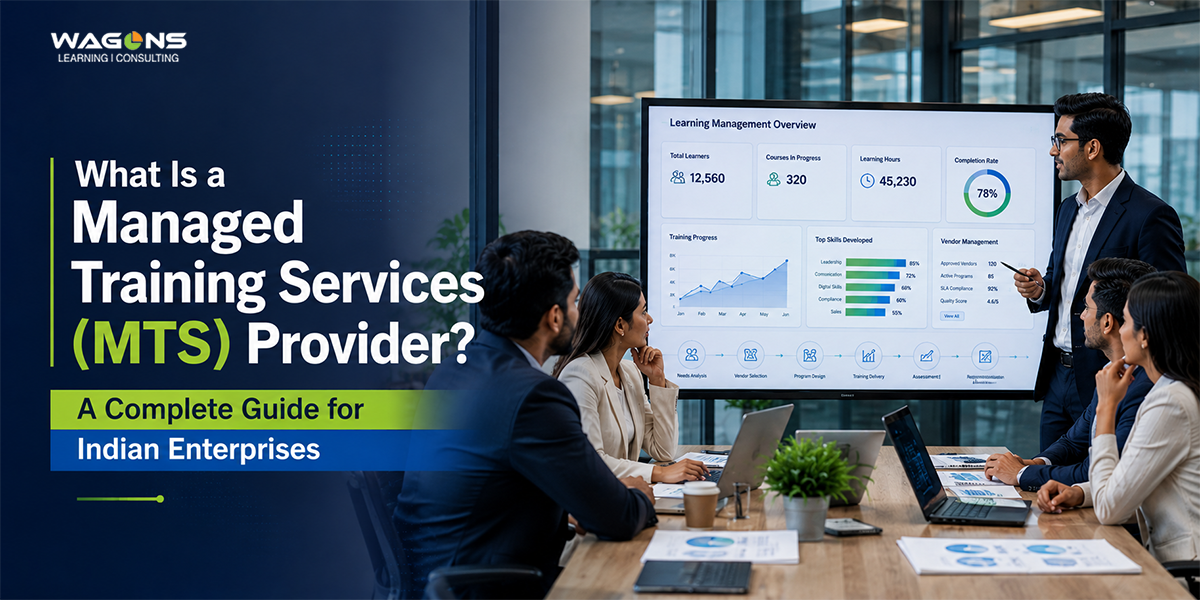
A Managed Training Services (MTS) provider is a specialist company that takes full or partial ownership of an enterprise’s training function covering design, delivery, administration, vendor management, technology, and measurement, under a single managed contract. Rather than building and running L&D in-house, the enterprise outsources this function to an MTS partner who is accountable for outcomes.
In short: MTS is to learning what IT outsourcing is to technology infrastructure.
Why Indian Enterprises Are Asking About MTS Right Now
India’s corporate learning market is at an inflection point. A 2024 KPMG report on Indian workforce trends found that 68% of large Indian enterprises plan to increase L&D spending, yet 57% simultaneously report that their internal training teams are understaffed. This paradox — more training needed, fewer people to run it — is precisely why searches for learning outsourcing services in India have grown 3x since 2022.
Add to this the pressure of rapid upskilling (AI, digital banking, EV transition, pharma digital), multi-location workforces, and the need to demonstrate training ROI to CFOs, and you have every reason to explore MTS.
What Does an MTS Provider Actually Do?
A qualified managed training services provider India typically delivers across six key pillars:
- Training Needs Analysis (TNA): Identifying skill gaps at the business unit, role, and individual level — not just running a survey but using data, competency frameworks, and manager input.
- Content Design & Development: Creating bespoke learning content, eLearning modules, videos, instructor-led programmes, simulations, and microlearning aligned to business outcomes.
- Learning Delivery Management: Scheduling, logistics, instructor coordination, and virtual/classroom delivery — whether for 50 or 50,000 learners across India.
- Training Administration: LMS administration, enrolment management, attendance tracking, reporting, and learner communications, freeing your team from operational overhead.
- Vendor Management: Consolidating and managing multiple training vendors (content, technology, facilitators) so you don’t have to juggle 12 supplier relationships.
- Measurement & Analytics: Reporting on completion rates, assessment scores, skill improvement, business impact, and ROI — the data CLOs need to justify L&D investment.
Benefits of Managed Training Services in India
For many organisations, the decision to partner with a managed training services provider in India is driven by more than cost savings. As workforce development becomes increasingly complex, enterprises are looking for ways to improve training effectiveness while reducing administrative burden.
Improved Cost Efficiency
MTS allows organisations to convert many of these fixed costs into a flexible service model, ensuring resources are aligned with actual training demand. This approach helps enterprises optimise L&D budgets without compromising learning quality.
Faster Training Deployment
An experienced managed training services provider can rapidly design, coordinate, and deploy learning programmes across multiple locations, reducing time-to-competency and enabling faster business execution.
Access to Specialised Learning Expertise
MTS providers offer access to instructional designers, learning consultants, facilitators, LMS administrators, content developers, and training analysts, allowing organisations to leverage specialised capabilities without expanding internal headcount.
Reduced Administrative Burden
Training coordination, learner communications, scheduling, reporting, vendor management, and LMS administration consume a significant portion of most L&D teams’ time. By outsourcing these operational responsibilities, organisations can allow internal learning leaders to focus on strategic initiatives.
Better Learning Measurement and ROI Visibility
One of the biggest challenges facing corporate learning teams is demonstrating business impact. A structured MTS model provides clear governance, reporting frameworks, and performance metrics that help organisations track participation, completion rates, skill development, compliance outcomes, and return on investment.
What Does MTS Include vs. Exclude?
MTS includes the management layer: strategy, governance, delivery coordination, and analytics. It can include content creation and technology (LMS/LXP) or work with your existing tools. What MTS typically excludes includes determining your business strategy (that stays with you) and replacing your HR function entirely.
Wagons Learning Offers End-to-End Managed Training Services for Indian Enterprises
From strategy and content to delivery, administration, and measurement — one partner, one contract, full accountability for your L&D outcomes.
MTS vs. In-House L&D: Which Is Right for You?
This is the most common question enterprises ask when exploring enterprise training outsourcing. Here is an honest comparison:
- Cost: In-house L&D carries fixed headcount costs year-round. MTS converts this to variable cost — you pay for what you use, and scale up or down with business cycles.
- Capability: An MTS provider brings a bench of specialists — instructional designers, LMS admins, facilitators, and data analysts — that most in-house teams cannot match.
- Speed: Need a training programme in 6 weeks for a new product launch? An MTS provider has the infrastructure. An in-house team starting from scratch does not.
- Control: Some L&D leaders worry about losing control. A good MTS contract specifies SLAs, governance meetings, escalation paths, and output ownership — giving you oversight without operational burden.
- Institutional Knowledge: The one area where in-house teams have an advantage is deep company context. The fix: a good MTS partner embeds into your organisation through a governance model, not just a contract.
Types of MTS Engagement Models
Not all MTS contracts look the same. Indian enterprises typically choose between three models:
1. Full L&D Outsourcing Services
The MTS provider takes ownership of the entire training function, including strategy, design, delivery, admin, technology, and measurement. Best for organisations that want to exit the training business entirely and focus on their core work.
2. Hybrid MTS Services
The enterprise retains strategic L&D decisions and senior L&D staff, while the MTS partner handles execution (content production, scheduling, admin, vendor management). Most common in India for enterprises with 2,000–20,000 employees.
3. Component-Level Outsourcing Services
Only specific components are outsourced — for example, just LMS administration, or just content development, or just training delivery logistics. An entry-level engagement that often grows into full MTS.
How to Evaluate a Managed Training Services Provider in India
When assessing MTS providers, L&D leaders in India should ask:
- Do they have experience in your industry (BFSI, pharma, manufacturing, IT)?
- Can they handle multi-lingual content and regional delivery across India?
- What is their LMS/LXP technology capability? Do they have one, or can they work with yours?
- How do they report on training outcomes — are SLAs and KPIs defined contractually?
- Do they offer a pilot or proof-of-concept before a full contract?
- What is their bench strength — number of instructional designers, facilitators, LMS admins?
The ROI Case for MTS in Indian Enterprises
Research from the Brandon Hall Group shows organisations using MTS providers report an average 22% reduction in cost-per-learner and a 31% improvement in training completion rates versus fully in-house models. For Indian enterprises managing 5,000+ employees across states, the logistics savings alone — travel, venue, coordination — can justify MTS within 18 months.
Beyond cost, the strategic ROI comes from speed: an MTS partner can deploy a compliance training programme across 10,000 employees in 4 weeks. In-house teams typically take 3–4 months to design, develop, and deliver equivalent content.
Want to Calculate Your MTS ROI?
Talk to a Wagons Learning consultant — a leading Managed Training Service Provider in India — and grow your business strategically.
FAQs on Managed Training Services
What is the difference between MTS and LMS?
An LMS (Learning Management System) is a technology platform for hosting, delivering, and tracking training. An MTS provider is a service organisation that manages your training function and may include LMS technology as part of its offering, or work with your existing LMS. Think of LMS as the tool and MTS as the team that uses and manages all the tools.
Is managed training services the same as training outsourcing?
They are closely related but not identical. Training outsourcing can refer to any external vendor delivering a single training programme. Managed Training Services is a broader, more strategic arrangement where the provider takes ongoing responsibility for multiple components of your L&D function under an SLA-based contract.
Which industries in India use MTS the most?
BFSI, pharmaceuticals, IT/ITES, manufacturing, and retail are the largest MTS users in India — sectors with large distributed workforces, high compliance requirements, or rapid digital transformation. However, MTS is increasingly relevant for healthcare, automotive, and infrastructure sectors too, and Wagons Learning caters to all of these industries.
How much does MTS cost in India?
MTS pricing in India varies significantly based on scope. Component-level MTS (e.g., LMS admin only) can start at ₹15–30 lakhs per year for mid-sized organisations. Full L&D outsourcing for a 5,000+ employee enterprise typically ranges from ₹1–5 crore annually, depending on content volume, headcount, technology, and SLA complexity.
Can small or mid-sized companies use MTS?
Yes. While MTS originated in large enterprise contracts, many providers now offer modular MTS for organisations with 500–5,000 employees. Starting with component-level outsourcing (e.g., content development + LMS admin) is a practical entry point.
How long does it take to set up an MTS contract?
A well-structured MTS transition takes 8–12 weeks from contract signing to full operational handover. This includes discovery, knowledge transfer, technology setup, and governance model establishment.
Does MTS replace my in-house L&D team?
Not necessarily. Many organisations retain a small internal L&D team for strategy, stakeholder management, and culture-specific content, while the MTS provider handles execution. This hybrid model is the most common in India.
Conclusion: Is MTS the Right Move for Your Organisation?
If your L&D function is struggling to scale, your training costs are rising without proportional outcomes, or your team is spending more time on administration than on learning strategy, then exploring a managed training services provider in India is the right next step.
MTS is not a loss of control. It is a transfer of the operational burden to specialists, so your business can focus on performance outcomes rather than training logistics.