Every year, enterprises spend millions on workforce upskilling, only to see minimal impact on bottom-line business performance. The culprit is almost always a flawed diagnostic process. When sales teams miss quarterly targets or operational errors rise across manufacturing facilities, leadership often assumes the immediate solution is more training.
However, deploying workshops without a rigorous diagnostic wastes budgets, frustrates employees, and fails to solve the underlying operational breakdown.
Conducting a data-driven training needs analysis is the critical first step in diagnosing workforce capability gaps. It ensures your corporate L&D budget is invested strictly in capabilities that move commercial KPIs.
This guide delivers a complete training needs analysis framework, providing an actionable blueprint to diagnose capability gaps, identify true root causes, and determine whether training is genuinely the right solution.
Quick Summary: What is a Training Needs Analysis (TNA)?
Direct Definition: A training needs analysis (TNA) is a systematic diagnostic process used by organizations to identify the gap between current employee capabilities and required job performance. It examines business objectives, evaluates operational workflows, and identifies the root cause of performance deficits to recommend targeted learning interventions or operational fixes.
Training Needs Analysis vs. Training Needs Assessment: What’s the Difference?
While often used interchangeably in corporate HR, these two concepts represent distinct phases of workforce evaluation:
- Training Needs Assessment: The broad data collection phase where HR teams gather qualitative and quantitative information through surveys, interviews, and performance audits.
- Training Needs Analysis: The strategic evaluation phase where specialists analyze that data, identify root causes, determine whether training is the appropriate solution, and design targeted intervention roadmaps.
The Core Question: Is Training Actually the Solution?
The fatal flaw of traditional L&D is treating every corporate problem as a learning deficit. Before designing any curriculum, enterprise leaders must ask: “Is this a lack of knowledge, or a systemic barrier?”
Step 1 – Identify Performance Deficit
Step 2 – Perform Root Cause Analysis
Step 3 – Determine the Root Cause:
- Knowledge / Skill Gap → Deploy Targeted Training → Practice Simulations → Behavioral Coaching
- Environmental Factor → Fix Tools / Systems → Clarify Incentives / KPIs → Redesign Workflows
If an automotive sales rep fails to log leads in a CRM because the software is slow or unintuitive, a 3-hour workshop on “CRM Best Practices” will fail. That is a tooling problem, not a skill problem.
A true employee training needs analysis isolates behavioral skill deficiencies from motivation, structural, or tooling bottlenecks.
The 3 Levels of Training Needs Analysis
A comprehensive diagnostic must examine capability requirements across three distinct organizational dimensions:
| Dimension | Focus Area | Diagnostic Objective | Example Scenario |
| 1. Organizational Level | Macro business strategy & strategic shifts | Organizational training needs analysis aligns learning initiatives with enterprise goals and market disruption. | Transitioning an entire banking workforce to adopt digital onboarding workflows. |
| 2. Operational / Task Level | Specific job roles & workflow requirements | Identifies the exact competencies and standard operating procedures (SOPs) needed for a role. | Mapping the critical negotiation steps required for B2B enterprise sales reps. |
| 3. Individual Level | Specific employee performance & capability | An individual training needs analysis evaluates individual proficiencies to deliver personalized upskilling pathways. | Assessing a junior manager’s proficiency in running structured performance appraisals. |
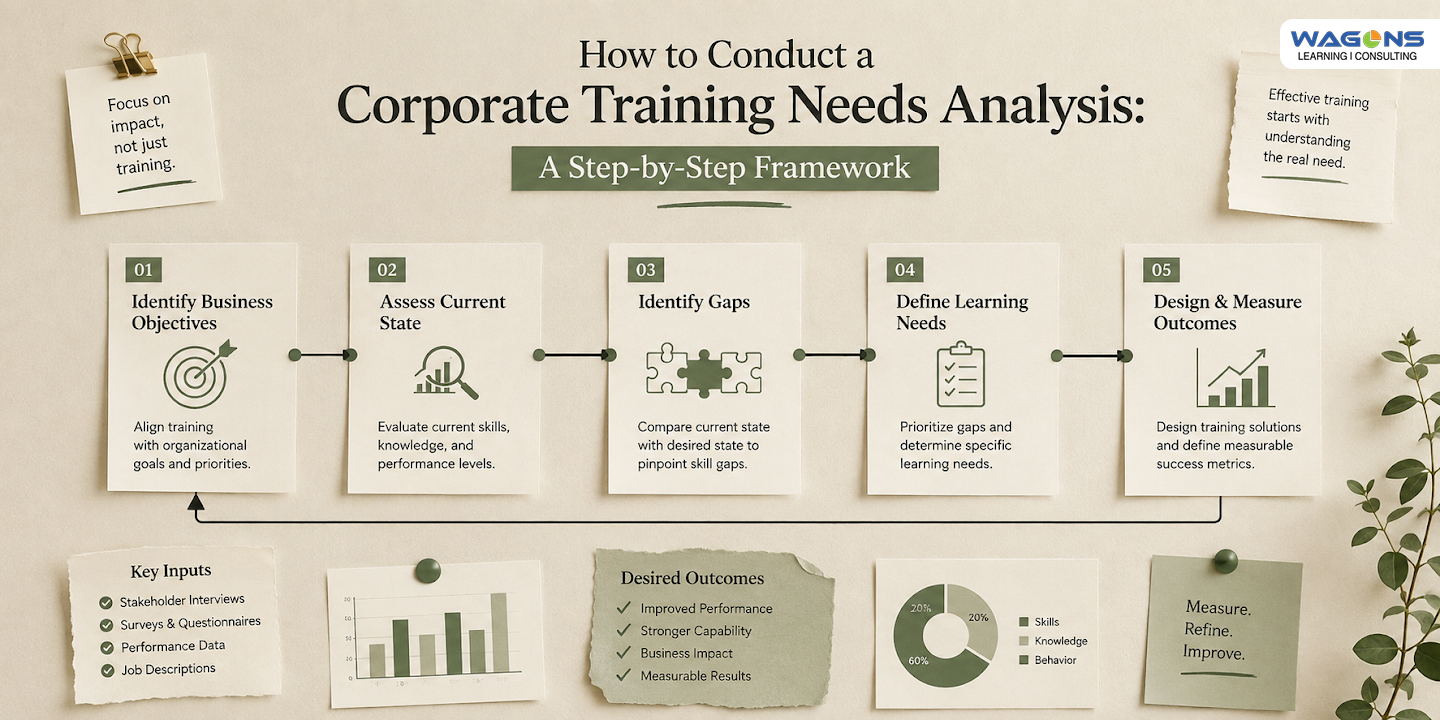
How to Conduct a Training Needs Analysis: The 8-Step Framework
To move from guesswork to strategic precision, follow these proven training needs analysis steps:
- Business Goal → 2. Desired Performance → 3. Current Performance → 4. Gap Isolation → 5. Root Cause Filter → 6. Triage & Priority → 7. Learning Action → 8. ROI Metric
Step 1: Identify the Business Problem
Never begin with a training request. Begin with a commercial KPI. Is customer churn increasing? Are manufacturing defect rates climbing? Clearly define the business outcome you need to improve.
Step 2: Define Desired Performance Standards
Determine what optimal execution looks like. Review SOPs, high-performer benchmarks, and compliance mandates to establish the target competency standard for the role.
Step 3: Measure Current Workforce Performance
Gather baseline performance data using reliable training needs analysis methods:
- Performance Metrics: CRM conversion rates, customer ticket resolution times, and quality assurance logs.
- Direct Observation: Shadowing frontline employees during live operational workflows.
- Workplace Surveys: Deploying a targeted training needs analysis questionnaire to capture self-reported operational challenges.
Step 4: Isolate the Skills Gap
Conduct a structured employee skills gap analysis. Compare the baseline performance captured in Step 3 against the benchmark defined in Step 2 to pinpoint exact capability shortfalls.
Step 5: Execute the Root Cause Filter (Training vs. Non-Training)
Analyze why the gap exists using the Mager and Pipe Performance Analysis Model:
- Can the employee execute the task if their job depended on it? If yes, it is a motivation, tool, or feedback issue, do not train.
- Is the performance deficit caused by a genuine lack of knowledge or practice? If yes, proceed with training.
Step 6: Prioritize Training Needs (The Risk vs. Impact Matrix)
Enterprises cannot train on everything simultaneously. Rank identified needs based on business impact, statutory compliance urgency, and operational risk.
Step 7: Design the Targeted Learning Intervention
Select the appropriate modality based on the complexity of the skill:
- Knowledge Acquisition: Microlearning modules and interactive e-learning.
- Behavioral Transformation: Scenario-based roleplay, simulation, and executive coaching.
- Procedural Mastery: Hands-on job shadowing and digital sandbox environments.
Step 8: Establish Evaluation Metrics (The ROI Baseline)
Define how success will be verified before launching the program. Establish clear pre- and post-training benchmarks tied directly back to the initial business problem.
Real-World Training Needs Analysis Examples
To understand how this training needs analysis process functions in enterprise settings, examine these two industry applications:
Example 1: BFSI Lending Division
- Business Problem: Personal loan disbursement turnaround time is lagging competitors by 48 hours.
- Root Cause Analysis: Credit officers understand underwriting rules, but struggle to navigate a newly updated automated risk verification dashboard.
- The Decision: Deploy a targeted digital simulation sandbox rather than a generic financial underwriting seminar.
- Result: 35% reduction in disbursement delays within 45 days.
Example 2: Automotive Manufacturing Plant
- Business Problem: High component rejection rates on the assembly line.
- Root Cause Analysis: Frontline assembly technicians in Tier-2 facilities are misinterpreting revised torque calibration sheets written exclusively in English.
- The Decision: Deploy localized, multilingual video micro-modules in Hindi and Marathi with visual checkpoints.
- Result: 28% drop in assembly defects.
Effective Training Needs Analysis Methods & Tools
Gathering clean, unbiased data requires utilizing multiple diagnostic channels:
- Skill Intelligence Diagnostics: Leveraging AI-powered diagnostic platforms to dynamically benchmark employee proficiencies against industry competency taxonomies.
- Structured Questionnaires: Deploying a training needs assessment questionnaire to gather qualitative employee feedback.
- 360-Degree Leadership Reviews: Gathering peer, direct report, and manager feedback to identify behavioral and leadership blind spots.
- Operational Audits: Reviewing real-time error logs, support tickets, and sales call recordings to identify recurring procedural failures.
- Standardized Documentation: Utilizing an enterprise training needs analysis template to ensure consistent scoring across diverse business units.
Frequently Asked Questions (FAQs)
What is the difference between a training needs analysis and a training needs assessment?
A training needs assessment is the data collection phase (surveys, interviews, observations). A training needs analysis is the strategic interpretation of that data to identify root causes, determine if training is the right intervention, and map learning outcomes to business goals.
What methods are used for training needs analysis?
Common training needs analysis methods include performance data audits, direct workplace observation, 360-degree feedback, structured stakeholder interviews, focus groups, competency assessments, and diagnostic surveys.
What is a skills gap analysis?
A skills gap analysis is a systematic comparison between the skills an organization currently possesses and the skills it needs to achieve its business objectives. It highlights specific capability deficits at the organizational, team, or individual level.
How do you identify employee training needs?
Employee training needs are identified through continuous performance tracking, manager appraisals, competency benchmarking, operational error audits, and structured training needs assessment questionnaire evaluations.
How do you know if training is actually needed?
Training is needed only when a performance deficit is caused by a genuine lack of knowledge, capability, or practice. If employees possess the necessary knowledge but fail to perform due to broken software, unclear incentives, or poor management, non-training operational solutions are required.
What should a training needs analysis report include?
A complete TNA report must contain the executive summary, identified business problems, baseline performance data, isolated skill gaps, root cause determinations (training vs. non-training), proposed learning modalities, estimated resource requirements, and projected ROI metrics.
Automate Your Training Diagnostics with Wagons Learning
Conducting an enterprise-wide training needs analysis across distributed business units and regional teams is complex. Relying on manual spreadsheets and subjective manager feedback often results in wasted training spend on the wrong problems.
Wagons Learning takes the guesswork out of enterprise capability building. Through our proprietary Skill Intelligence platform and end-to-end Managed Training Services (MTS), we diagnose your workforce capability gaps in real time, build contextualized custom learning programs, and deliver verifiable business outcomes across India and the UAE.
Schedule a Corporate Diagnostic Consultation to transform your workforce capabilities today.