Every fiscal year, global enterprises invest billions of dollars in workforce learning initiatives. Yet, when board members and Chief Financial Officers ask what return that investment produced, many corporate L&D leaders point to attendance records, completed course modules, and post-session satisfaction surveys.
Relying on surface-level feedback creates a massive accountability vacuum. Knowing that employees “enjoyed” a workshop provides zero evidence that they learned a skill, changed their on-the-job behavior, or contributed to commercial business goals.
Implementing the Kirkpatrick model of training evaluation remains the gold standard for bridging this measurement gap.Originally developed by Dr. Donald Kirkpatrick in the 1950s and continually refined for modern enterprise environments, this framework allows organizations to systematically trace the thread connecting a classroom or digital learning intervention to tangible operational and financial performance.
This guide provides an executive overview of the Kirkpatrick model of training evaluation, detailing how each of the four levels of training evaluation works, real-world corporate examples, and how modern organizations use a “backward design” approach to guarantee commercial training returns.
Quick Summary: What is the Kirkpatrick Model of Training Evaluation?
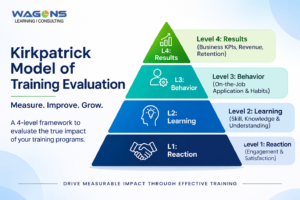
Direct Definition: The Kirkpatrick model of training evaluation is a globally recognized four-tier framework designed to assess the effectiveness and impact of corporate training programs. It measures training across four progressive levels: Level 1 (Reaction) evaluating learner engagement and relevance; Level 2 (Learning) assessing knowledge and skill acquisition; Level 3 (Behavior) tracking on-the-job behavioral application; and Level 4 (Results) measuring organizational business performance and financial ROI.
The 4-Tier Evaluation Pyramid
The Four Levels of Training Evaluation Explained
To measure learning impact rigorously, enterprise L&D teams must evaluate programs through each distinct operational stage:
Level 1: Reaction (Engagement, Satisfaction & Relevance)
Level 1 measures how learners respond to the training intervention.
- Beyond the “Smile Sheet”: Traditional Level 1 evaluations ask superficial questions: “Was the lunch good?” or “Was the room comfortable?” Modern Level 1 surveys focus on utility, relevance, and perceived applicability:
- Did this content directly address a specific workflow bottleneck?
- Will you be able to apply these frameworks immediately on the job?
- Was the instructional pacing and platform technology frictionless?
Level 2: Learning (Knowledge, Skills & Confidence Delta)
Level 2 measures what learners know, can execute, or believe as a direct result of the program.
- Measuring the Skill Delta: Rather than relying on a standalone quiz at the end of a module, effective Level 2 evaluations utilize pre- and post-program assessments to measure the net skill gain.
- Evaluation Formats: Objective knowledge exams, software sandbox simulations, role-play demonstrations scored against standardized rubrics, and learner self-efficacy ratings.
Level 3: Behavior (Application on the Job & Workflow Habit Formation)
Level 3 measures whether employees actively apply what they learned when they return to their daily work environment.
- The Bridge from Knowing to Doing: This is where traditional corporate training usually fails. An employee may score 100% on a compliance or sales assessment (Level 2), yet revert to old habits the following morning.
- Evaluation Formats: Standardized manager observation rubrics conducted 30, 60, and 90 days post-training, peer 360-degree feedback, customer interaction quality audits, and system usage logs.
Level 4: Results (Commercial Business Impact & Organizational ROI)
Level 4 measures the ultimate organizational impact of the training program.
- Aligning with C-Suite Priorities: CFOs, COOs, and business unit directors judge training programs exclusively by Level 4 metrics. Did the program solve the business problem that triggered the expenditure?
- Evaluation Formats: Reductions in operational error rates, lower customer churn, accelerated new-hire time-to-productivity, decreased workplace safety incidents, increased sales conversions, or direct bottom-line cost savings.
Detailed Enterprise Examples Across All 4 Levels
To see how the Kirkpatrick model of training evaluation functions in corporate practice, review these practical applications across three enterprise training domains:
Enterprise Example 1: B2B Enterprise Sales Enablement Program
- Business Problem: Long enterprise sales cycles and lower-than-projected deal closing ratios for high-margin software solutions.
- Level 1 (Reaction): Sales reps give the module a 4.6/5.0 score, with 91% stating that the new consultative objection-handling frameworks directly address common client pushbacks.
- Level 2 (Learning): Sales reps achieve an average score increase of 38% between the baseline pre-assessment and the final simulation exam; reps pass a live mock pitch evaluated by sales directors.
- Level 3 (Behavior): CRM pipeline audit at 60 days confirms that 84% of reps are consistently documenting client discovery pain points using the new qualification rubric.
- Level 4 (Results): Average deal closing velocity accelerates by 19 days, and quarterly conversion rates across participating sales teams lift by 14.5%, adding ₹3.2 crore in incremental revenue.
Enterprise Example 2: Digital Personal Data Protection (DPDP) Compliance Training
- Business Problem: High operational risk of regulatory fines and audit non-compliance under India’s DPDP Act across regional branches.
- Level 1 (Reaction): 94% of customer service associates agree that the scenario-based modules made complex legal consent requirements easy to comprehend.
- Level 2 (Learning): Randomized post-module assessments demonstrate a 98% first-time pass rate on identifying unauthorized data processing requests.
- Level 3 (Behavior): Internal quality assurance audits show customer support agents verifying customer consent before modifying account profiles 99.4% of the time, up from 72%.
- Level 4 (Results): Zero regulatory compliance non-conformances during external statutory audits, and customer data privacy complaints drop by 68% over two quarters.
Enterprise Example 3: Manufacturing Plant Safety & Machine Calibration
- Business Problem: Rising component scrap rates and high near-miss safety incidents on an automotive assembly line.
- Level 1 (Reaction): Plant floor technicians report that visual video SOPs accessible via QR codes are significantly more useful than printed 50-page technical manuals.
- Level 2 (Learning): Technicians demonstrate 100% calibration accuracy during practical digital machine setup simulation checks.
- Level 3 (Behavior): Weekly supervisor observation audits confirm 96% compliance with Lockout/Tagout (LOTO) protocols and proper torque calibration sequences.
- Level 4 (Results): Component assembly scrap rates drop by 28%, saving ₹90 lakhs in rework costs, while Lost-Time Injury (LTI) frequency reaches zero for 180 consecutive days.
The “Reverse Kirkpatrick” Approach: Starting with Level 4
A major reason enterprise L&D programs struggle to prove ROI is that they evaluate forwards (Level 1 → Level 2 → Level 3 → Level 4). By the time leadership tries to calculate Level 4 results, the training content has already been built without clear alignment to a business metric.
High-impact organizations practice The Reverse Kirkpatrick Design Model:
- Start with Level 4 (The Business Goal): What specific commercial KPI needs improvement? (e.g., “Reduce loan disbursement cycle time by 48 hours.”)
- Determine Level 3 (The Required Behaviors): What must employees do differently on the job to move that metric? (e.g., “Credit underwriters must reconcile GST filings digitally before manual reviews.”)
- Map Level 2 (The Learning Objectives): What knowledge, frameworks, and practice do they need to execute that behavior? (e.g., “Hands-on training on digital GST tax reconciliation tools.”)
- Deliver Level 1 (The Engaging Experience): What instructional format will deliver this learning with zero friction? (e.g., “Short-form interactive micro-simulations accessible via mobile devices.”)
Comprehensive Comparison Matrix: Levels 1 Through 4
| Evaluation Level | Primary Metric | Timing of Measurement | Key Measurement Tools | Typical Operational Challenge |
| Level 1: Reaction | Engagement, Relevance, Net Promoter Score | Immediately post-training (Day 0) | Digital pulse surveys, CSAT forms, LMS telemetry | Biased responses; positive scores do not guarantee learning. |
| Level 2: Learning | Skill delta, knowledge retention, pass rate | During & immediately after program | Pre/post exams, branching scenario sandboxes | Testing artificial memorization rather than deep comprehension. |
| Level 3: Behavior | On-the-job habit transfer, SOP adherence | 30 to 90 days post-training | Manager observation rubrics, 360 reviews, CRM audits | Requires direct manager involvement and time commitment. |
| Level 4: Results | Commercial KPIs, cost reduction, net ROI | 90 to 365 days post-training | Business intelligence dashboards, ERP/P&L metrics | Isolating training impact from other market or operational variables. |
Frequently Asked Questions (FAQs)
What is the Kirkpatrick model of training evaluation?
The Kirkpatrick model is a four-tier framework used by organizations worldwide to measure the effectiveness of training programs across four levels: Reaction, Learning, Behavior, and Results.
What is the hardest level of the Kirkpatrick model to measure?
Level 4 (Results) and Level 3 (Behavior) are the most challenging. Level 3 requires ongoing observation and cooperation from line managers over 30 to 90 days, while Level 4 requires isolating the specific financial or operational contribution of training from external market factors.
What is the difference between Level 2 and Level 3 evaluation?
Level 2 measures what an employee learned during the training (knowledge or skill demonstration in a test or simulation). Level 3 measures whether the employee actually applies that learning in their daily work environment once they return to the job.
Can the Kirkpatrick model be used for digital e-learning and microlearning?
Yes. Modern Learning Management Systems (LMS) and Learning Record Stores (LRS) track Level 1 engagement metrics (drop-off velocity, feedback) and Level 2 knowledge checks automatically. Digital observation checklists and CRM/ERP integrations make tracking Level 3 behaviors and Level 4 business results seamless.
What is the Phillips ROI model, and how does it relate to Kirkpatrick?
The Phillips ROI model adds a fifth level to the Kirkpatrick framework: Return on Investment (ROI). Level 5 explicitly calculates the net monetary benefits of a training program compared to its total operational and development costs, expressing the result as a percentage ratio.
Prove the Value of Your Training Investments with Wagons Learning
Collecting hundreds of feedback forms without measuring business performance leaves your L&D budget vulnerable to executive skepticism. Demonstrating measurable capability growth requires an integrated evaluation ecosystem that connects learner engagement directly to commercial ROI.
Wagons Learning delivers turnkey corporate training programs engineered for measurable impact across India and expanding business corridors in Dubai and the UAE.
Powered by our proprietary Skill Intelligence platform and comprehensive Managed Training Services (MTS), we deploy pre- and post-learning assessments, digital manager observation rubrics, and custom analytics dashboards that track training effectiveness from Level 1 learner reaction to Level 4 commercial business results.
Explore Wagons Skill Intelligence Solutions to measure your true L&D return on investment today.