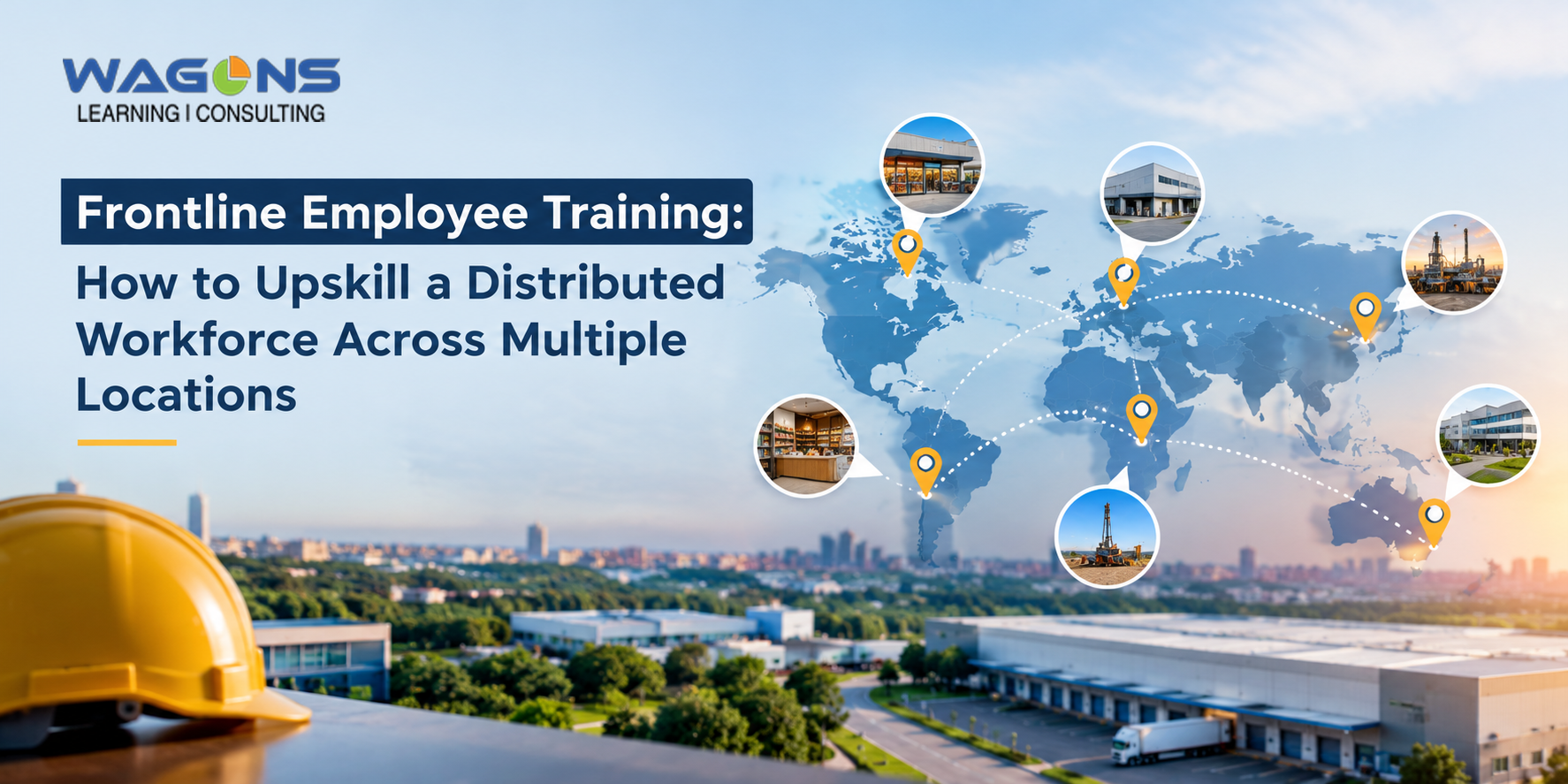
Across high-velocity enterprise operations in retail networks, manufacturing plants, automotive dealerships, and logistics hubs, frontline workers represent the core operational engine. They assemble components, operate machinery, manage inventory, and interact directly with customers. Yet, across distributed enterprise environments in India and expanding GCC hubs in Dubai and the UAE, frontline employee training remains an operational bottleneck.
Traditional corporate training frameworks were engineered for desk-bound employees with dedicated workstations and flexible calendars. Forcing deskless staff to attend off-site classroom lectures or complete 60-minute desktop modules between shifts creates operational downtime, low compliance, and minimal skill retention.
Building a resilient, high-performing organization requires an agile framework for frontline workforce training programs. When deskless teams lack structured enablement, enterprises suffer from elevated shop-floor defect rates, customer service escalations, safety violations, and frontline attrition rates frequently exceeding 40% annually.
This practical operational guide demonstrates how enterprise organizations can design, execute, and scale frontline employee training solutions across hundreds of distributed locations without disrupting daily commercial operations.
Quick Summary: What is Frontline Employee Training?
Direct Definition: Frontline employee training is the specialised enterprise methodology of building operational, technical, safety, and customer-facing capabilities for deskless workers operating in physical, non-office environments. It combines mobile-first microlearning, localized vernacular content, supervisor-led on-the-job coaching, and rapid digital skill assessments to drive immediate standard operating procedure (SOP) adherence.
The Operational Reality of the Deskless Workforce
Enterprise L&D leaders must design programs that account for the unique operational constraints of deskless teams: Failing to recognize these differences leads to the “LMS desert” phenomenon: expensive software platforms deployed by central HR that frontline workers never log into.
The 4 Core Pillars of Scalable Frontline Workforce Learning
To successfully train thousands of distributed workers across retail stores, manufacturing lines, and logistics hubs, organizations must anchor their strategy on four structural pillars:
Pillar 1: Mobile-First Microlearning in the Flow of Work
Replace 45-minute slide decks with 2-to-4-minute bite-sized digital nuggets accessible via smartphones or floor terminals. Frontline workers consume modules during pre-shift huddles, floor changeovers, or natural operational pauses.
Pillar 2: High-Volume Multilingual Localisation
Delivering safety protocols or retail customer service standards in English to workers whose primary language is Hindi, Marathi, Tamil, or Kannada leads to immediate operational failure. Scalable deskless workforce training requires native vernacular voiceovers and culturally contextualized visuals.
Pillar 3: Visual SOPs and Scenario-Based Checkpoints
Convert dense paper manuals into visual video SOPs. Workers learn by watching 60-second visual demonstrations, followed by interactive decision checkpoints where they spot safety hazards or resolve customer dilemmas.
Pillar 4: Supervisor-Led Floor Observation Checklists
Digital learning must connect directly to physical floor execution. Equip shift supervisors and store managers with digital observation checklists on mobile tablets to audit and verify on-the-job competency after an employee completes digital training.
Frontline Training by Industry Vertical: Retail vs. Manufacturing vs. Logistics
A critical error is treating all frontline workers identically. Each industry vertical operates under distinct commercial pressures and risk profiles:
| Operational Dimension | Retail Frontline Teams | Manufacturing Plant Technicians | Logistics & Field Distribution |
| Core Operational Focus | Transaction speed & customer experience | Zero-defect assembly & equipment safety | Delivery SLA speed & route safety |
| Critical Competencies | POS operation, cross-selling, de-escalation | Machine calibration, LOTO, visual inspection | Parcel handling, mobile app logging, driving |
| L&D Delivery Mechanism | Mobile micro-video & simulated checkout | QR-code video SOPs on machines & floor huddles | Offline audio snippets & pre-shift checks |
| Cost of Failure | Lost immediate sale, negative public review | Machine downtime, industrial injury, scrap | Delayed delivery penalty, cargo damage |
| Primary Business KPI | Average Basket Value (ABV), conversion rate | Lost-Time Injury (LTI) rate, scrap percentage | First-attempt delivery rate, turnaround time |
Overcoming the 4 Critical Barriers to Deskless Workforce Enablement
Implementing scalable frontline employee training across hundreds of distributed facilities introduces operational barriers rarely encountered in corporate headquarters:
1. Device Diversity & The BYOD Challenge
Unlike office workers issued standardized corporate laptops, frontline workers either share kiosks or use personal Android smartphones spanning varying screen sizes and operating system versions.
- The Solution: Content must be authored in lightweight HTML5 with responsive layouts that consume minimal device memory. Avoid heavy video files that drain employee personal data plans; leverage compressed, vector-based animated illustrations and concise audio snippets.
2. Bandwidth Scarcity in Industrial & Underground Facilities
Retail basements, steel fabrication plants, and rural distribution centers frequently experience zero cellular connectivity.
- The Solution: Deploy an LMS supporting native offline caching. When workers connect to the facility’s local Wi-Fi during their morning clock-in, the app automatically downloads the day’s 2-minute focus module. Once completed, progress statements sync to the central server when connectivity resumes.
3. Shift Fatigue & Cognitive Load Management
A factory technician who has stood on an assembly line for 7 hours or a retail cashier who has processed 150 transactions will not engage with a theoretical 45-minute evening e-learning course.
- The Solution: Shift from cognitive “learning events” to “operational performance support.” Embed training directly into daily shift routines: 2-minute visual reminders during shift changeovers, interactive 3-question quizzes during floor huddles, and QR-code visual aids placed directly on physical equipment.
4. Language Nuance & Vernacular Cultural Context
Direct English-to-Hindi or English-to-Tamil text translations often produce awkward, overly formal phrasing that confuses blue-collar workers.
- The Solution: Employ native regional instructional designers who understand colloquial floor dialects. A safety instruction for an automotive assembly plant in Pune must use the exact Marathi terminology technicians use on the shop floor, rather than academic Marathi translations.
4 Strategic Frontline Training Tracks for Enterprise Operations
To maximize commercial returns, organizations should structure deskless workforce training across four core functional tracks:
Track 1: High-Speed Frontline Onboarding (Day 1 to 14)
- Primary Objective: Accelerating basic floor readiness and ensuring zero statutory compliance violations.
- Key Curriculum: Company culture video overviews, basic workplace safety guidelines, statutory POSH and DPDP privacy essentials, and emergency evacuation protocols.
- Delivery Format: 3-minute mobile micro-modules paired with an assigned peer mentor for practical on-the-job shadowing.
Track 2: Technical Standard Operating Procedure (SOP) Mastery
- Primary Objective: Eliminating manufacturing defects, improper machine operation, and quality variations.
- Key Curriculum: Step-by-step equipment calibration, Lockout/Tagout (LOTO) procedures, tool maintenance schedules, and component quality inspection rubrics.
- Delivery Format: QR-code-activated micro-videos mounted on plant machinery and simulated hazard-spotting visual challenges.
Track 3: Customer Service & Transaction Velocity (Retail & Hospitality)
- Primary Objective: Elevating customer Net Promoter Scores (NPS), increasing conversion rates, and reducing POS checkout delays.
- Key Curriculum: Point of Sale (POS) system shortcuts, de-escalating angry shoppers, suggestive upselling techniques, and handling product returns.
- Delivery Format: Interactive branching decision scenarios and simulated checkout sandboxes on floor tablets.
Track 4: Frontline Supervisor & Shift Lead Enablement
- Primary Objective: Upskilling high-performing floor workers into effective shift managers to curb frontline team attrition.
- Key Curriculum: Running effective 10-minute shift huddles, delivering constructive behavioral feedback, conflict resolution between shifts, and dynamic labor scheduling.
- Delivery Format: Blended cohorts, peer practice circles, and mobile-based coaching observation rubrics.
The 5-Stage Implementation Framework for Multi-Location Frontline Skilling
Deploying enterprise-grade mobile employee training across distributed locations requires a disciplined operational model:
Stage 1: Operational Needs Analysis & Shift Mapping
Audit the frontline working day. Identify peak operational rushes and dead periods to establish exact training windows. Pinpoint the top 3 operational failure points (e.g., cashier scanning errors, assembly line torque calibration mistakes).
Stage 2: Rapid Visual Micro-Content Authoring
Convert SOP binders into short, engaging visual formats: 90-second machinery videos, illustrated safety cards, and interactive 3-question quizzes. Ensure all content is translated into required regional languages.
Stage 3: Lightweight, Mobile-First LMS Deployment
Deploy an LMS that requires minimal bandwidth, operates reliably on low-end Android smartphones, and supports offline content caching. Authentication should be frictionless—using mobile OTP or QR badges rather than complex corporate network credentials.
Stage 4: Execution During Shift Huddles & Floor Lulls
Integrate learning into routine floor management. Shift supervisors open daily 10-minute team huddles by reviewing a 2-minute daily focus module, turning training into an operational routine.
Stage 5: Supervisor Observation & Real-Time Remediation
Supervisors conduct weekly 5-minute digital observation audits on individual workers. If a worker fails a practical floor check, the system automatically triggers a refresher micro-module to close the gap.
Stage 6: Centralized Reporting & Capability Benchmarking
Consolidate data across all branches, plants, and distribution centers into a centralized Skill Intelligence dashboard. Identify lagging facilities and correlate training completion with regional operational KPIs.
Measuring Frontline Training Success: The Operational Scorecard
Executive management must evaluate frontline training by tracking operational capability rather than course clicks:
| Evaluation Tier | Frontline Operational Metric | Measurement Mechanism | Business Impact |
| Speed to Competency | Time-to-Floor Readiness | Days from hire date to first unassisted shift | Accelerates operational capacity and lowers labor overtime. |
| Process Accuracy | Standard Operating Procedure (SOP) Compliance | Supervisor digital observation audit scores | Reduces operational errors, rework, and waste. |
| Workplace Safety | Lost-Time Injury (LTI) Frequency | Monthly safety incident and near-miss logs | Protects workforce safety and reduces regulatory liability. |
| Commercial Performance | Average Transaction Value (ATV) / Scrap Rate | Daily POS sales logs or plant scrap reports | Directly lifts revenue or lowers manufacturing operating costs. |
| Workforce Stability | 90-Day Frontline Retention Rate | HRMS turnover data across regional facilities | Lowers constant re-recruiting and basic onboarding expenses. |
Frequently Asked Questions (FAQs)
What is frontline employee training?
Frontline employee training is the structured enablement of deskless workers who operate on retail sales floors, factory assembly lines, logistics warehouses, and field locations. It emphasizes practical SOP adherence, safety compliance, and customer service execution delivered via mobile and on-the-job formats.
How do you train employees who do not have computers or corporate emails?
Deskless employees are trained using mobile-first Learning Management Systems (LMS) accessible on personal smartphones or shared floor tablets. Systems utilize mobile phone OTPs or employee ID badges for frictionless login, featuring short microlearning modules that require minimal internet bandwidth.
Why is multilingual training critical for frontline workers?
Frontline workforces across India and the GCC encompass diverse linguistic backgrounds. Delivering training exclusively in English creates cognitive barriers and misinterpretation of safety or operational standards. Translating content into regional vernacular languages ensures total comprehension and operational compliance.
How can companies train employees across multiple distributed locations consistently?
Consistency is achieved by combining centralized digital microlearning modules that standardize core knowledge with decentralized supervisor observation rubrics that verify physical floor execution across all branches or plants.
What is the role of shift supervisors in frontline training?
Shift supervisors serve as the critical bridge between digital instruction and daily execution. They lead pre-shift huddle discussions, conduct on-floor competency observations using digital checklists, and provide immediate, real-time coaching when operational mistakes occur.
Upskill Your Frontline Workforce with Wagons Learning
Scaling frontline capability across hundreds of retail stores, manufacturing lines, or regional branches should not result in operational downtime, high attrition, or inconsistent quality. Modern enterprise execution requires a partner capable of delivering engaging, multilingual learning directly to the factory floor or sales counter.
Wagons Learning delivers turnkey frontline employee training solutions engineered specifically for high-velocity enterprises across India and expanding corporate hubs in Dubai and the wider UAE.
Powered by our proprietary Skill Intelligence platform and end-to-end Managed Training Services (MTS), we author localized microlearning video content, deploy lightweight mobile LMS platforms, and implement supervisor observation frameworks that turn your deskless workforce into an operational competitive advantage.
Consult an Enterprise Workforce Specialist to scale your frontline workforce capability today.