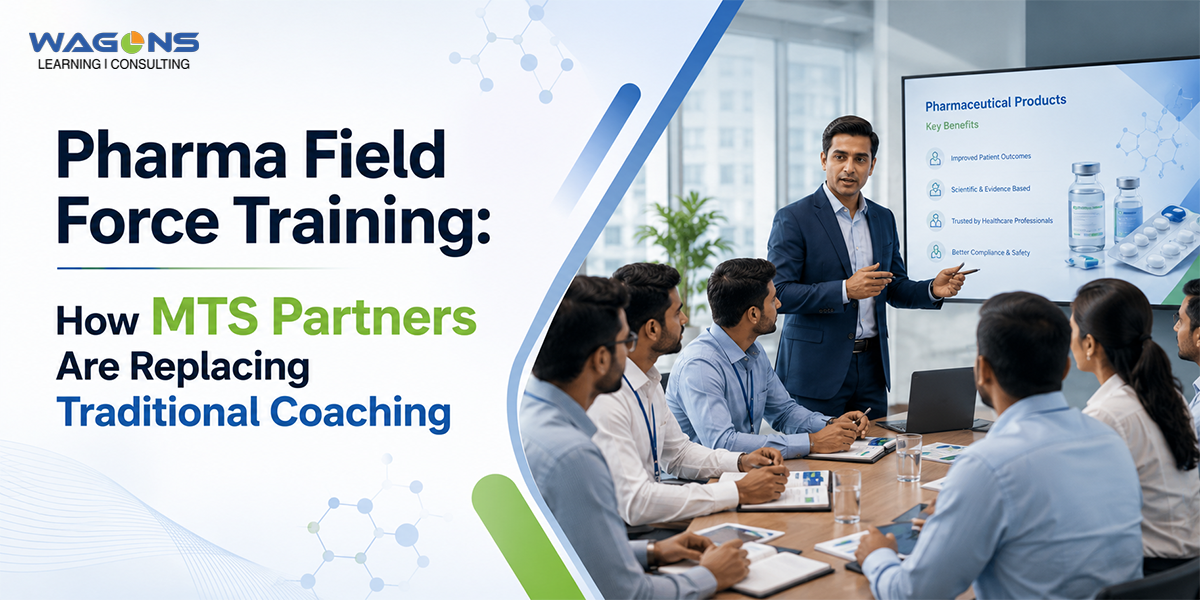
India’s pharmaceutical industry employs over 600,000 medical representatives and field sales professionals, one of the largest field forces in the world. For decades, this workforce was trained through a simple model: regional training managers conducting classroom sessions in hotel conference rooms, followed by field rides with area business managers.
In 2026, this model is being displaced, not supplemented, displaced, by digital, data-driven, MTS-managed learning programmes. This guide covers what is driving this transformation, what pharma field force training must now include, and what Indian pharma companies should demand from their training partners.
Why Traditional Pharma Field Force Training Is Failing
The traditional coaching model has four structural weaknesses that have become critical in 2026:
- Coverage problem: A training manager can personally coach 20–30 MRs. A pharmaceutical company with 5,000 MRs needs 150+ trainers for the same coverage. Most companies have 15–20.
- Consistency problem: What the training manager in Ahmedabad teaches and what the trainer in Hyderabad teaches about the same product may differ significantly, leading to inconsistent scientific communication with doctors.
- Recall problem: A 2-day classroom session on a new molecule has a retention rate of 20–30% after 2 weeks. An MR standing in front of a cardiologist who asks a complex question about the drug’s mechanism of action cannot consult their training manual.
- Measurement problem: ‘Field rides completed’ and ‘attendance at training event’ are not measures of sales capability. Most pharma companies cannot answer: ‘Do our MRs actually know the product better after training?’
What Modern Pharma Field Force Training Must Include in 2026
1. Digital Product Certification Modules
Pharma training LMS India deployments are replacing classroom product training with structured digital certification journeys. A new product launch training now typically includes: a 45-minute self-paced eLearning module on the molecule (mechanism of action, clinical data, approved indications), a 20-question assessment with a minimum 80% pass mark required for certification, and a 15-minute practice simulation where the MR handles a virtual doctor’s objection.
2. CLM (Closed Loop Marketing) Integration Training
CLM training pharma India has become essential as pharma companies invest in digital detailing tools (Veeva, Salesforce Health Cloud, custom CLM apps). MRs need training not just on the app mechanics but on how to use digital content effectively in a 7-minute doctor visit, which panels to show, in what sequence, how to respond to questions triggered by the CLM content.
3. Field Force Effectiveness (FFE) Skills
Beyond product knowledge, MR training programs 2026 must build: effective call planning and territory management, KOL engagement skills, objection handling frameworks specific to the therapy area, and pharmacovigilance reporting obligations.
4. Regulatory and Compliance Training
UCPMP (Uniform Code for Pharmaceutical Marketing Practices) compliance, pharmacovigilance (PV) reporting, and CDSCO update awareness are non-negotiable training areas for Indian pharma field forces. These must be updated within weeks of regulatory changes, a capability that only digitally-managed training systems can deliver.
5. Continuous Reinforcement
The most critical innovation in pharma field force training is post-training reinforcement. Field force effectiveness training programmes now include weekly 5-minute microlearning pushes on product facts, therapy area news, and competitive intelligence, delivered via a mobile app, that maintain knowledge between quarterly training events.
Wagons Learning designs and manages pharma field force training programmes for leading Indian pharmaceutical companies. Explore our Pharma L&D solutions.
How MTS Partners Are Replacing Traditional Training Managers
A pharmaceutical training outsourcing model through an MTS partner replaces the regional training manager model with:
- A centralised content team that builds product training, CLM integration modules, and compliance content to a single standard
- A pharma-domain LMS/LXP that delivers training to every MR via their smartphone, tracks completions, and generates assessments
- A data-driven field coaching model where the MTS partner’s trainers conduct virtual coaching calls focused on assessed gaps not generic observation
- Monthly reporting to the training head showing MR certification rates, assessment performance by product and region, and correlation with SFE (Sales Force Effectiveness) metrics
FAQ
What is CLM training for the pharma field force?
CLM (Closed Loop Marketing) training equips medical representatives with the skills to use digital detailing tablets effectively during doctor visits. It covers: how to navigate the CLM application, how to present digital content persuasively in a short call, how to capture doctor feedback, and how CLM data feeds back into the company’s marketing analytics.
How is pharma field force training delivered in India?
Modern pharma field force training in India uses a blended model: initial product certification via eLearning on a pharma LMS, virtual instructor-led sessions for launch training and complex therapy areas, CLM app-based digital detailing practice, continuous reinforcement via mobile microlearning, and periodic field coaching (virtual or in-person) targeted at assessed skill gaps.
What is the UCPMP and how does it affect pharma training?
The UCPMP (Uniform Code for Pharmaceutical Marketing Practices) is India’s self-regulatory framework governing how pharmaceutical companies promote their products to healthcare professionals. MR training must explicitly cover UCPMP compliance, and evidence of this training may be requested during CDSCO audits.
How do you measure pharma field force training effectiveness?
Beyond completion rates, effective pharma L&D measurement tracks: assessment scores pre and post training, certification attainment rates by product and region, call quality scores from field managers, doctor prescription data correlation (where CRM data allows), and pharmacovigilance report accuracy rates.
Conclusion: The MR of 2026 Is a Digitally Trained Professional
The medical representative of 2026 is not trained in a hotel conference room once a quarter. They are continuously certified on the company’s LMS, reinforced with weekly microlearning on their phone, coached virtually on specific gaps identified by their assessment data, and equipped with CLM tools that make every doctor interaction data-driven. Those still running traditional classroom-based coaching programmes are not. The window for transition is now and MTS partners with pharma domain expertise are the fastest route to getting there.
Wagons Learning empowers pharmaceutical companies in India and the UAE to build modern field force training programs with digital certification. Let’s talk.