In a business landscape increasingly dominated by AI and automation, a strange paradox has emerged. The most critical capability gaps in the 2026 enterprise are no longer technical; they are entirely human.
Companies frequently boast teams that are technically brilliant but struggle to collaborate in hybrid environments, communicate with empathy, or resolve complex conflicts. This is the soft skills gap, and it is directly stalling enterprise productivity.
When teams lack these behavioral competencies, the symptoms are immediate and costly:
- Project delays due to misaligned communication between departments.
- High turnover rates caused by friction between employees and their direct managers.
- Decreased customer satisfaction stemming from poor problem-solving capabilities.
Providing targeted soft skills training for employees is no longer a supplementary HR initiative. It is a mandatory business strategy required to build a resilient, high-performing workforce that can navigate rapid market changes.
What is Soft Skills Training for Employees?
Soft skills training for employees is the systematic process of developing interpersonal capabilities, such as strategic thinking, communication, and emotional intelligence, enabling them to navigate complex workplace dynamics and improve overall job performance.
While hard skills (like coding, operating machinery, or financial modeling) dictate what an employee does, soft skills determine how they do it. Unfortunately, many organizations still treat these critical behavioral competencies as inherent traits rather than skills that require structured, corporate training.
To understand the distinction in a modern enterprise context:
- Hard Skill: Operating a new enterprise CRM software.
- Soft Skill: Persuading a reluctant client to renew their contract using insights extracted from that CRM.
- Hard Skill: Running a complex data analysis report.
- Soft Skill: Presenting that data to non-technical stakeholders without causing confusion or overwhelming them.
The Most Critical Soft Skills for 2026
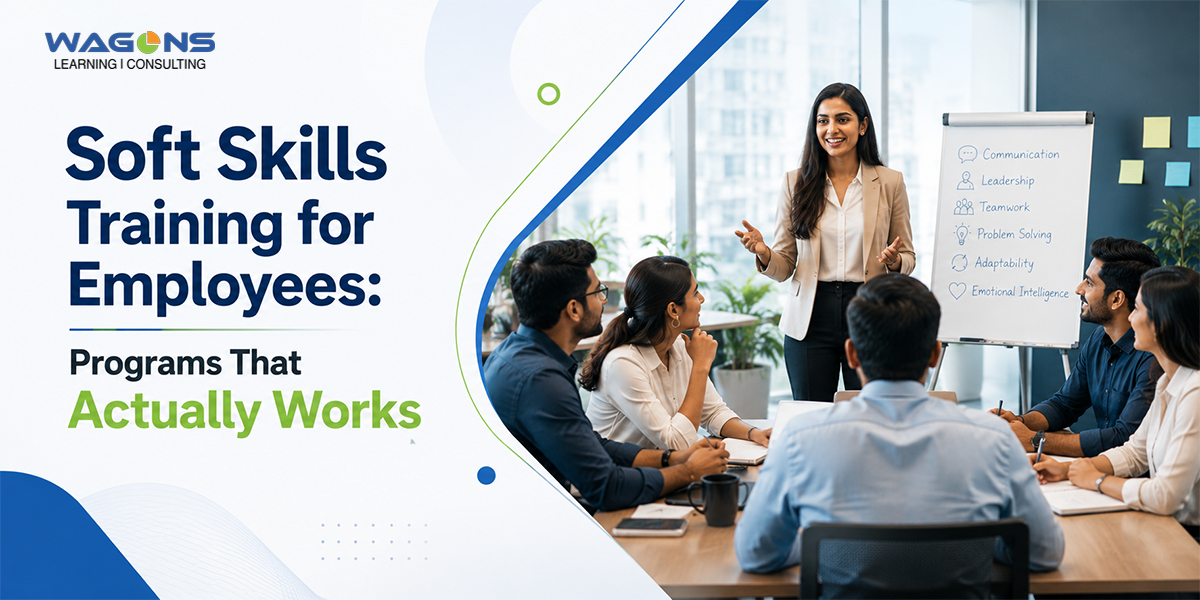
The definition of “good communication” has evolved drastically. Based on 2026 corporate training trends, businesses are shifting away from generic workshops and focusing on specific behavioral capabilities tailored to hybrid and AI-augmented workplaces.
Here are the top soft skills your workforce needs today:
- Advanced Cognitive Flexibility: The ability to adapt to new AI tools and shifting operational protocols without experiencing change fatigue. Business Impact: Reduces operational friction during digital transformations.
- Strategic Communication: Moving beyond basic clarity to mastering active listening, interpreting non-verbal cues in virtual meetings, and delivering concise feedback. Business Impact: Eliminates costly back-and-forth emails and operational misunderstandings.
- Cross-Functional Collaboration: The capacity to break down departmental silos and work effectively across different enterprise functions. Business Impact: Accelerates product launches and improves internal agility.
- Emotional Intelligence (EQ): Recognizing and managing personal emotions while understanding the emotional states of team members and clients. Business Impact: Prevents burnout and builds psychological safety within high-pressure teams.
- Conflict Resolution: Equipping employees with the tools to turn workplace friction into productive, problem-solving discussions. Business Impact: Keeps high-stakes projects on track when internal disagreements arise.
Why Generic Soft Skills Training Solutions Fail
One of the biggest mistakes L&D leaders make is purchasing off-the-shelf soft skills training solutions. A generic module on “Empathy” might work for a retail setting, but it is practically useless for a B2B sales team navigating complex, multi-million-dollar negotiations.
Effective corporate soft skills training must be deeply contextualized to your specific industry and daily workflows.
- Context is King: Employees instantly disengage when scenarios do not reflect their daily realities or industry pressures.
- The Illusion of Competence: Watching a video about active listening does not make someone a better listener. They need a safe environment to practice, fail, and receive feedback.
- No Accountability: Generic programs rarely track whether the employee actually applied the learned behavior on the job, making ROI impossible to calculate.
Traditional vs. Modern Soft Skills Training Solutions
If your corporate soft skills training consists of putting employees in a room for a two-hour lecture, your return on investment (ROI) will be zero. Behavioral change cannot be achieved through passive listening. Modern capabilities require modern delivery methods.
| Feature | Traditional Training | Modern Solutions (2026) |
| Delivery | Static classroom lectures or long videos. | Blended learning, micro-nudges, and immersive AI roleplay. |
| Focus | Generic communication tips and theory. | Scenario-based problem solving tied to real business KPIs. |
| Measurement | “Smiley face” satisfaction surveys (Smile Sheets). | Capability density and time-to-proficiency metrics. |
| Scalability | Strictly limited by trainer availability and travel. | Scalable across thousands of employees via advanced platforms. |
(Note: Transitioning from traditional methods to a modern framework is complex. This is where partnering with a specialized provider for Managed Training Services ensures your programs are scalable, consistent, and measurable across your entire enterprise.)
How to Build Programs That Actually Work
To ensure your corporate soft skills training delivers tangible business outcomes, L&D leaders must adopt a systematic, data-driven approach.
1. Diagnose Before You Design
Never implement training based on a subjective managerial request. Use objective assessments to determine if a performance issue is actually a skill gap, a motivation issue, or a systemic operational barrier.
- Leverage 360-degree feedback tools to gain multiple perspectives.
- Use behavioral benchmarking to identify exactly where the communication breakdown is occurring.
- Avoid relying solely on self-reported surveys, as employees rarely identify their own behavioral blind spots.
2. Tie Training to Business Outcomes
Organize your soft skills programs around strategic business goals rather than generic subject catalogs. Training should always be deployed to solve a specific business problem.
- Instead of launching “Conflict Resolution Training,” target the goal of “Reducing internal HR escalations by 20%.”
- Instead of generic “Communication Skills,” target “Accelerating Digital Sales Cycle Times.”
3. Deploy Simulation and Practice
Knowledge retention requires practice. The highest-value corporate training programs in 2026 use scenario-based simulations and AI-augmented roleplay to close the gap between knowing a skill and executing it under pressure.
- Employees can practice difficult conversations with virtual avatars before speaking with real clients.
- Managers can simulate performance reviews before conducting real ones, ensuring they deliver feedback constructively.
(Wagons Learning specializes in deploying customized, scenario-based soft skills training solutions designed specifically for the unique pressures of the Indian enterprise market. Our Skill Intelligence platform seamlessly maps these behavioral gaps to targeted learning interventions, ensuring maximum relevance.)
4. Measure Performance, Not Participation
Stop measuring success by completion rates or learning hours. In 2026, the metrics that matter to the C-suite are business KPI correlation and demonstrated capability mastery.
- Pre-and Post-Assessments: Measure the baseline behavioral capability before the training and test it again 30 to 60 days later.
- Manager Observation: Track behavioral changes through structured, ongoing manager feedback loops.
- Business Impact: Monitor the specific business KPI you identified in step two to prove the financial value of the training.
Frequently Asked Questions (FAQs)
Q: Can soft skills actually be taught, or are they natural personality traits?
A: Yes, they can be taught. While some individuals have natural inclinations, capabilities like active listening, structured problem-solving, and conflict resolution are distinct frameworks that can be learned, practiced, and mastered through targeted corporate soft skills training.
Q: How long does it take to see the results of corporate soft skills training?
A: Unlike technical training (where results can be immediate), behavioral change takes time. Most organizations begin to see measurable shifts in team dynamics and performance metrics within 60 to 90 days, provided the training includes continuous reinforcement and manager coaching.
Q: Why are soft skills training solutions critical for hybrid and remote teams?
A: Remote work removes natural, face-to-face social cues. Employees must intentionally over-communicate, build trust digitally, and resolve conflicts without the benefit of in-person interactions. This requires a much higher level of strategic communication and emotional intelligence than traditional office settings.
Q: How do we measure the ROI of soft skills training solutions?
A: ROI is measured by tracking specific business outcomes before and after the intervention. Look for reductions in customer complaints, improved team retention rates, shorter project completion times, and a decrease in internal HR conflict resolutions.
Q: What is the biggest mistake companies make with soft skills development?
A: The most common failure is treating soft skills as a one-time event (like an annual retreat or a single webinar). Effective behavioral change requires continuous learning, micro-nudges, and ongoing coaching integrated directly into the flow of work.
Ready to upgrade your workforce capabilities? Wagons Learning provides end-to-end L&D solutions that turn capability gaps into competitive advantages. Contact us today to explore our custom enterprise training programs and Managed Training Services.