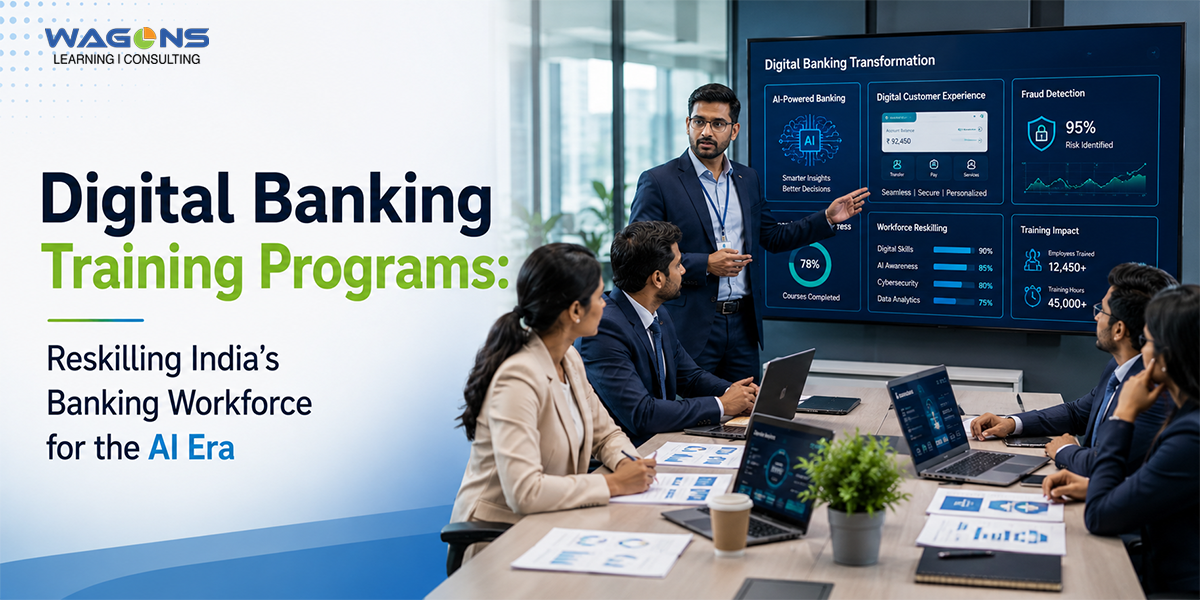
India’s banking sector is undergoing its most significant transformation in decades. With UPI processing over 18 billion transactions a month, RBI mandating stricter KYC and AML compliance, and neo-banks disrupting traditional branch banking, the skills required of a bank employee in 2026 look nothing like 2019. Yet most banking training programs India organisations run today were designed for a pre-digital workforce. This guide explores what modern digital banking training must include, how AI is reshaping learning in BFSI, and what L&D heads at Indian banks need to act on now.
Why Banking Workforce Reskilling Is Urgent in 2026
The data is unambiguous. The Indian Banking & Finance Institute (IIBF) estimates that over 40% of current banking roles will be significantly altered by AI and automation by 2028. Three forces are driving this:
- AI-powered banking tools — from credit underwriting algorithms to chatbots handling 80% of customer queries — are replacing tasks, not just automating them.
- Regulatory pressure — RBI’s 2025 guidelines on digital lending, cybersecurity, and climate risk require bankers to master new compliance domains within 12-month windows.
- Neo-banking competition — fintechs are hiring digital-native talent, forcing PSU and private banks to upskill existing employees or risk a talent gap at the point of customer interaction.
Benefits of Digital Banking Training Programs
For Indian banks, digital banking training is no longer just a learning initiative — it is a business necessity. As AI, automation, digital payments, and regulatory requirements reshape the banking landscape, organisations that invest in structured workforce upskilling gain measurable advantages across operations, compliance, customer experience, and revenue growth.
1. Faster Adoption of Digital Banking Products
New mobile banking features, lending platforms, payment solutions, and customer self-service tools only deliver value when employees understand how to use and support them. Effective digital banking training programmes help staff become confident users and advocates of new products, accelerating adoption across both employees and customers.
2. Improved Regulatory Compliance
With RBI regularly issuing new guidelines on digital lending, cybersecurity, outsourcing risk, and customer protection, banks must ensure employees stay current with evolving requirements. Well-designed training programmes reduce compliance gaps, minimise regulatory risk, and help create a culture of accountability across the organisation.
3. Increased AI Readiness Across the Workforce
AI is rapidly becoming part of everyday banking operations — from fraud detection and credit assessment to customer service and sales forecasting. Digital banking training equips employees with the knowledge needed to work alongside AI tools, interpret AI-driven insights, and apply them responsibly in customer-facing and operational roles.
4. Better Customer Experience and Digital Engagement
Today’s customers expect seamless digital experiences across mobile apps, internet banking, video banking, and payment platforms. Training relationship managers, branch staff, and service teams on digital channels enables faster issue resolution, stronger customer interactions, and improved satisfaction scores.
5. Stronger Protection Against Fraud and Cyber Threats
As banking transactions become increasingly digital, employees represent the first line of defence against cyber risks. Training programmes that cover fraud detection, phishing awareness, cybersecurity best practices, and digital risk management help reduce operational vulnerabilities and improve organisational resilience.
What Modern Digital Banking Training Programs Must Cover
1. Digital Product Knowledge
Bank staff — from frontline relationship managers to back-office processors — must deeply understand digital products: mobile banking, payment APIs, co-branded credit cards, and embedded finance offerings. Traditional classroom product training cannot keep pace with monthly product updates. Digital banking upskilling India programmes must include just-in-time microlearning modules accessible on mobile, updated in real time.
2. Regulatory & Compliance Training
RBI compliance training India is non-negotiable and increasingly complex. Effective programmes in 2026 integrate:
- AML/KYC refreshers delivered as scenario-based eLearning with real-case simulations
- PMLA and cybersecurity modules with quarterly updates to reflect RBI circulars
- Climate risk and ESG disclosures — a rapidly growing compliance requirement for Indian banks per RBI’s 2024 Framework on Climate Risk
- Outsourcing risk and vendor management as per the RBI Master Direction on IT
3. AI and Data Literacy
Perhaps the most critical and most overlooked area of bank workforce reskilling is AI literacy. This does not mean turning every banker into a data scientist. It means:
- Understanding how AI models generate credit decisions and being able to explain them to customers
- Using AI tools for sales forecasting, portfolio risk alerts, and customer personalisation
- Recognising AI-generated fraud patterns and responding appropriately
4. Customer Experience & Digital Sales
As footfall in branches declines and digital acquisition rises, relationship managers need digital-first sales skills — including using CRM platforms effectively, handling video banking interactions, cross-selling via WhatsApp banking, and converting digital leads through the bank’s app.
5. Neo-Banking & Fintech Partnerships
Fintech upskilling bank employees now includes understanding co-lending models, API banking partnerships, and the bank’s role in fintech ecosystems. This is particularly critical for product, operations, and tech staff.
Bespoke Digital Banking Training for Indian BFSI Organisations
Wagons Learning designs bespoke digital banking training programmes — from compliance eLearning to AI literacy workshops — tailored for Indian BFSI organisations.
The Role of MTS Partners in Banking L&D Transformation
Most Indian banks — including mid-sized private banks and cooperative banks — lack the internal L&D infrastructure to manage the scale and complexity of BFSI digital transformation training. A Managed Training Services (MTS) partner brings:
- Dedicated instructional designers with BFSI domain expertise
- Content update workflows to reflect monthly RBI circulars within 2 weeks
- LMS/LXP management for pan-India delivery across branches and remote staff
- Multilingual content in Hindi, Tamil, Telugu, Kannada, and Bengali for regional banking staff
- Measurement frameworks tracking both completion and on-the-job behaviour change
Case Example: How a Private Sector Bank Reskilled 12,000 Staff in 6 Months
A large private sector bank partnered with an MTS provider to execute BFSI digital transformation training ahead of a mobile banking platform launch. The programme included: 4 hours of self-paced eLearning on the new platform, 2 hours of live virtual role-play sessions with relationship managers, a compliance certification module for branch managers, and a microlearning series of 5-minute refreshers pushed to staff phones weekly post-launch.
Result: 97% completion rate within 6 months, customer complaint rate on the new platform dropped 42% in Q1, and branch staff Net Promoter Score for the new app reached 8.1/10.
Building a Banking Training Programme for 2026: A Framework
- Audit first: Map current skill levels against your 2026 digital strategy. Identify the top 10 critical skill gaps.
- Segment your learners: Branch staff, operations staff, relationship managers, compliance officers, and tech teams all need different content and formats.
- Go mobile-first: 73% of banking employees in India access training on smartphones. If your content isn’t optimised for mobile, you’re losing completions.
- Make compliance engaging: Dry compliance eLearning gets ignored. Use branching scenarios, real case studies (anonymised), and gamification for compliance modules.
- Measure beyond completion: Track on-the-job indicators — error rates, customer satisfaction scores, regulatory audit outcomes — as your training KPIs.
FAQ: Digital Banking Training in India
What is RBI compliance training for bank employees?
RBI compliance training refers to mandatory training programmes aligned with Reserve Bank of India guidelines — covering KYC/AML, cybersecurity, climate risk, digital lending, and outsourcing risk management. Under RBI’s Master Directions, banks are required to ensure all relevant staff complete defined training hours annually. Non-compliance attracts regulatory action.
How do Indian banks train staff on new digital products?
Leading Indian banks use a combination of LMS-based self-paced eLearning for product knowledge, live virtual instructor-led sessions for complex features, microlearning pushes on mobile for updates, and on-the-job coaching by team leaders post-launch. The trend is moving from classroom-first to digital-first delivery.
How often should banking compliance training be refreshed?
At minimum, annually for most compliance modules. However, with RBI issuing multiple circulars per quarter, banks should build a rapid content update workflow — ideally within 2 weeks of a new directive — rather than waiting for annual refreshes.
What technology do Indian banks use for training delivery?
Most large banks use enterprise LMS platforms (SAP SuccessFactors, Cornerstone, or custom-built LMS). Mid-sized banks increasingly adopt LXP (Learning Experience Platform) solutions that support mobile-first, personalised learning paths.
Is AI literacy training mandatory for bank employees in India?
Not yet mandated by RBI, but increasingly included in banks’ own competency frameworks. Given RBI’s focus on AI governance in banking, it is expected that AI literacy will become a regulatory expectation within 2–3 years.
Conclusion: The Banks That Train for 2026 Will Win the Decade
The Indian banking sector’s digital transformation is not a future event — it is happening right now, branch by branch, screen by screen. The banks that invest in structured, scalable, modern banking employee training 2026 programmes will emerge with a workforce ready for AI-powered banking. Those that do not will find their staff — and their customers — choosing competitors who feel more digital.
Partner With Wagons Learning for Digital Banking Training at Scale
Wagons Learning partners with banks and NBFCs across India to design and deliver digital banking training programmes at scale.