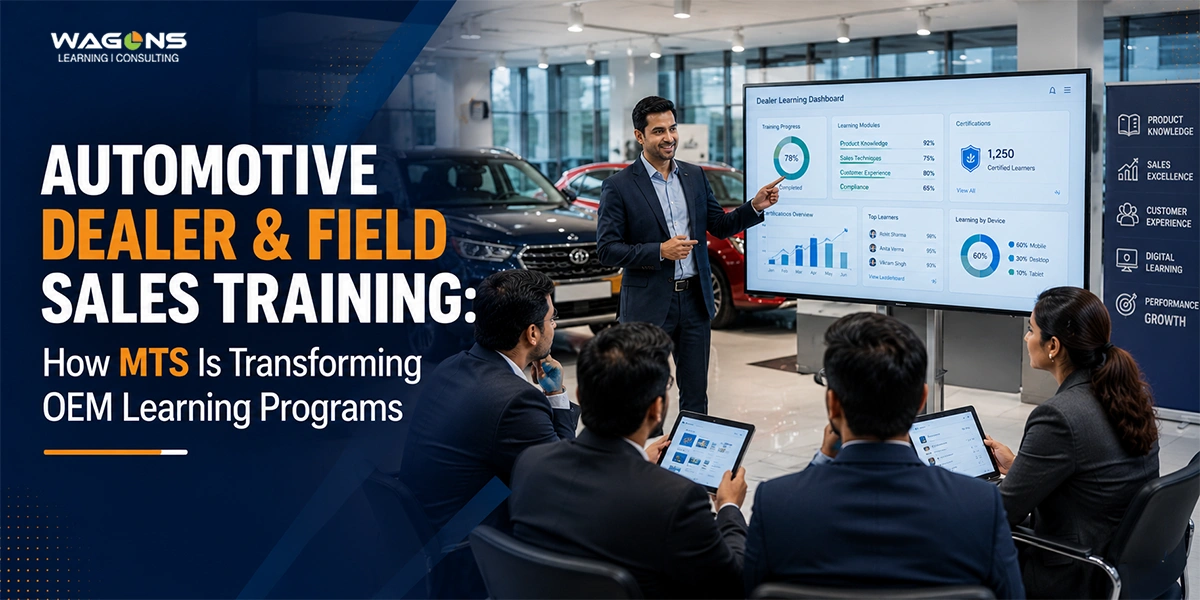
India is now the third-largest automobile market in the world, with over 4.2 million passenger vehicles sold in FY2024–25. But behind every sale is a dealer network that is under enormous pressure: selling EVs alongside ICE vehicles, managing complex digital retail journeys, and navigating a rapidly changing product portfolio. For OEMs, the quality of their automotive dealer training program in India determines whether their dealer network is an asset or a liability. This guide explores how Managed Training Services (MTS) partners are transforming OEM learning programs and what it means for training heads at India’s leading automakers.
Why Automotive Dealer Training Is More Complex Than Ever
A dealer showroom today is not what it was five years ago. Sales consultants are expected to:
- Explain the difference between hybrid, plug-in hybrid, and full EV drivetrains to a customer in 90 seconds
- Demo connected car features on an infotainment system that receives over-the-air updates monthly
- Navigate a digital-first test drive booking, finance calculator, and delivery workflow on a CRM platform
- Handle objections about EV range anxiety with accurate, confident data
- Upsell accessories, extended warranties, and service plans using consultative selling skills
Traditional automotive dealer training in India — a 2-day classroom event at the regional office, twice a year — cannot address this complexity. The shift from product-push to consultative selling, and from ICE to multi-powertrain, requires continuous, role-specific, digitally delivered learning.
The Scale Challenge: Training India’s Dealer Network
India’s top OEMs operate dealer networks ranging from 800 to 5,000+ touch points across Tier 1, Tier 2, and Tier 3 cities. Each dealership has sales consultants, service advisors, parts managers, and front-desk staff — all requiring different training. A mid-sized OEM with 1,500 dealers and an average of 8 trained staff per dealer is looking at 12,000 people to train, scattered across 29 states, speaking 12+ languages.
No in-house L&D team can manage this at scale. This is precisely why OEM L&D functions across India are moving to Managed Training Services models.
Training Field Sales Teams in Automotive OEMs
While dealer training receives significant attention, field sales teams play an equally critical role in automotive retail performance. Area sales managers, regional sales officers, dealer development executives, and territory managers act as the link between OEM strategy and dealer execution. Without effective field sales training, even the most comprehensive dealer learning programmes struggle to deliver consistent results.
Modern automotive sales training in India must equip field teams with skills that go beyond product knowledge.
Territory and Dealer Performance Management
Field sales professionals are increasingly responsible for improving dealership performance through data-driven decision-making. Training programmes should cover dealership KPI analysis, sales funnel management, inventory planning, market intelligence gathering, and action planning to improve retail performance across assigned territories.
Dealer Coaching and Capability Development
Rather than simply auditing dealerships, modern field sales teams must function as dealer coaches. Automotive field sales training programmes should develop skills in performance coaching, sales observation, feedback delivery, and capability building to help dealer staff improve conversion rates and customer engagement.
EV Dealer Readiness and Retail Execution
As OEMs expand their electric vehicle portfolios, field teams are often responsible for ensuring dealer readiness. This includes validating EV infrastructure preparedness, supporting EV sales certification programmes, coaching dealer staff on EV customer conversations, and monitoring execution of EV retail standards at the dealership level.
Digital Retail and CRM Adoption
Automotive retail is increasingly driven by digital customer journeys. Field sales managers need training on CRM utilisation, lead management processes, digital retail platforms, test-drive conversion tracking, and online-to-offline customer engagement strategies. This enables them to guide dealers in adopting OEM-led digital initiatives effectively.
Channel Partner and Dealer Management Skills
Dealer relationship management remains a core competency for automotive field teams. Training should focus on stakeholder management, conflict resolution, business review facilitation, negotiation skills, and collaborative planning to strengthen OEM-dealer partnerships and improve long-term network performance.
For OEMs operating large dealer networks, combining automotive dealer training programmes with structured field sales training creates a more effective learning ecosystem.
How MTS Partners Are Transforming OEM Learning Programs
Centralised Content, Decentralised Delivery
A skilled MTS partner designs OEM-standard content centrally — ensuring brand consistency, accuracy, and compliance — and delivers it digitally to every dealer across India simultaneously. A new product launch training that once took 6 months (regional trainers travelling to dealers) now takes 6 weeks through a blended MTS model.
Role-Based Learning Paths
Effective automobile sales training in 2026 is not one-size-fits-all. MTS providers design distinct learning paths for:
- Sales Consultants: Product knowledge, EV sales certification, digital retail skills, objection handling
- Service Advisors: Technical diagnostic basics, customer communication, upselling service packages
- Dealer Principals / GMs: Business performance, financial management, HR practices
- Parts Managers: Inventory management, digital catalogues, vendor coordination
EV-Specific Certification Programs
EV sales training India has emerged as a standalone, high-priority training category for OEMs launching electric vehicles. MTS partners are designing structured EV certification journeys that include battery technology basics, charging ecosystem knowledge, government subsidy schemes (FAME-II, state EV policies), and EV-specific objection handling — culminating in a certified EV Sales Specialist badge that dealers can display.
Automotive After-Sales Training
After-sales is where dealer revenue and OEM customer retention metrics live. Automotive after-sales training covers: service advisor communication skills, service package upselling, warranty claim process adherence, and customer satisfaction score (CSS/VSS) improvement. MTS partners build scenario-based eLearning that puts service advisors in virtual service bays, making training sticky and measurable.
Automotive Dealer Training Designed for Indian OEMs
Wagons Learning designs and manages automotive dealer training programs for Indian OEMs — from EV certification to after-sales excellence.
The MTS Model for Automotive OEMs: How It Works
- Discovery & TNA: The MTS partner maps dealer competency gaps against OEM sales and service KPIs
- Content Development: Role-specific eLearning, product videos, scenario simulations, and assessment banks are developed with OEM product teams
- LMS/LXP Deployment: A dealer-facing learning portal (with SSO from dealer DMS) provides anytime access to all content
- Delivery Coordination: Virtual ILT sessions for complex topics (EV tech, new model launches) are scheduled and managed by the MTS team
- Reporting & Governance: Monthly dashboards showing completion rates by dealer, region, and role — tied to sales performance data where possible
FAQ
What training do automotive dealers need in India?
Indian automotive dealers require training across four areas: product knowledge (including EV and technology features), sales skills (consultative selling, digital retail, test drive facilitation), service excellence (for after-sales teams), and operational/business management (for dealer principals and GMs).
How do OEMs train their dealer network at scale in India?
Leading OEMs use a combination of a dealer-facing LMS/LXP for self-paced product and skill learning, virtual instructor-led training (VILT) for product launches and certification, a field trainer network for in-dealership coaching, and an MTS partner to coordinate all of these elements centrally while tracking outcomes by dealer.
What is EV sales certification for Indian auto dealers?
EV sales certification is a structured training and assessment programme that qualifies dealer sales consultants to sell electric vehicles confidently. It covers battery technology, charging infrastructure, total cost of ownership comparisons, government subsidies, and EV-specific objection handling.
Conclusion: Dealer Excellence Is an OEM’s Competitive Advantage
In India’s intensely competitive auto market, the difference between winning and losing a sale often happens on the showroom floor. Dealer staff who know their products deeply, sell consultatively, and handle EV transitions confidently give OEMs a sustainable edge. Automotive dealer training program India delivered through an MTS model is the most scalable, measurable, and cost-efficient way to build and maintain that edge.
Partner With Wagons Learning for OEM Dealer Training
We manage end-to-end dealer L&D for automotive brands across India & UAE — from EV certification to after-sales excellence.