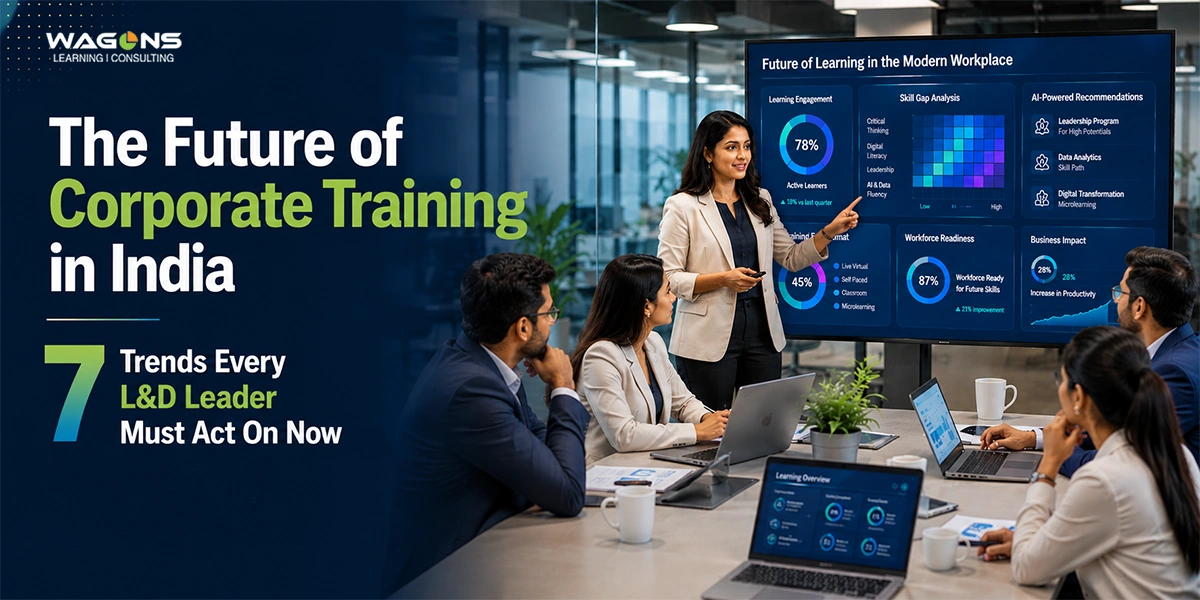
The future of corporate training in India 2026 is not coming — it has arrived. From generative AI redesigning content creation to Gen Z workers refusing to sit through a 2-hour compliance video, the forces reshaping enterprise learning are no longer theoretical. This report, written for CLOs, CHROs, and HR Directors who set L&D strategy for Indian enterprises, identifies the 7 most consequential trends and what each means for your training investment decisions right now.
Why 2026 Is a Turning Point for Indian L&D
India’s corporate training market was valued at approximately ₹52,000 crore in 2024 (KPMG India, 2024) and is projected to grow at 14% CAGR through 2028. But growth in spend does not automatically translate into growth in impact. The organisations separating from competitors are not the ones spending more — they are the ones spending differently: on technology, personalisation, outcomes measurement, and strategic outsourcing.
Trend 1: Generative AI Is Rewriting Content Creation
The most immediate impact of AI on corporate training India is in content development speed. Instructional designers using AI tools (prompt-to-storyboard, AI voiceover, auto-generated assessments) are producing eLearning modules 40–60% faster than 2022 benchmarks. This has two major implications: organisations can update content in near-real-time (no more 18-month content refresh cycles), and budgets previously spent on production can shift to personalisation and measurement.
The risk: AI-generated content without instructional design oversight produces technically accurate but pedagogically poor learning. The hybrid model — human designers directing AI tools — is the winning formula.
Trend 2: Skills-Based Learning Replaces Job-Based Training
The shift to skills-based organisations is accelerating in India. Rather than training people in the generic skills attached to a job title, leading enterprises are building skills taxonomies and delivering learning mapped to specific skill nodes. This means a software developer gets a personalised learning path based on their actual skill gaps (say, cloud architecture and prompt engineering) rather than a generic ‘Tech Upskilling’ programme. Skill intelligence platforms that map, assess, and route learning based on individual skill profiles are moving from pilot to mainstream.
Trend 3: Gen Z Learners Are Forcing Format Redesign
By 2026, Gen Z comprises approximately 27% of India’s organised workforce — and they learn differently. Gen Z training preferences are unambiguous: mobile-first, 5–10 minute formats, video-led, feedback-rich, and connected to career impact. They will abandon a 60-minute eLearning module at minute 8. They will complete a 6-minute scenario-based video with an assessment if it earns them a badge. L&D functions that haven’t redesigned their content format strategy for this audience are already losing engagement.
Trend 4: Hybrid Learning Is the Default Delivery Model
The post-COVID assumption that ‘digital learning will replace classroom training’ has been refined. The hybrid learning future combines: self-paced digital learning (product knowledge, compliance, technical skills), virtual instructor-led sessions (complex skills, case studies, team learning), and in-person events (culture, leadership, team cohesion). The art is in sequencing — knowing which learning objectives require human interaction and which are better served digitally.
Hybrid L&D Programmes for Indian Enterprises
Wagons Learning designs hybrid L&D programmes — blending digital, virtual, and in-person learning for maximum impact.
Trend 5: Learning Measurement Is Moving from Activity to Impact
India’s CLOs are under growing board-level pressure to demonstrate training ROI. The shift is from measuring what was completed (completion rates, hours of training) to measuring what changed (skill improvement, behaviour change, business outcomes). Organisations adopting Kirkpatrick Level 3 and 4 measurement — asking ‘did learners actually apply this?’ and ‘did business outcomes improve?’ — are using learning analytics platforms and post-training manager surveys to make this real.
Trend 6: Managed Training Services Are Moving from Large Enterprises to Mid-Market
MTS was once the preserve of 10,000+ employee organisations. In 2026, the managed training services market India is seeing strong growth among mid-sized enterprises (1,000–5,000 employees) who cannot afford to build the full internal L&D infrastructure required by modern training. Modular MTS — where specific components (content development, LMS admin, vendor management) are outsourced while strategic L&D stays in-house — is the growth segment.
Trend 7: AI in L&D Is Driving Personalisation at Scale
AI in corporate training India is enabling something previously impossible: truly personalised learning at scale. LXPs (Learning Experience Platforms) with AI recommendation engines analyse a learner’s role, skill gaps, learning history, and performance data to serve the right content at the right time. For a 50,000-employee enterprise, this means each employee gets a different learning path — not a different content catalogue, but a genuinely different sequence and format tailored to their needs.
Challenges L&D Leaders Will Face in Corporate Training
The future of corporate training in India is creating new possibilities for organisations, but it is also introducing new challenges for L&D leaders responsible for building effective learning strategies.
Connecting Corporate Training With Business Outcomes
One of the biggest challenges for L&D leaders is ensuring that corporate training programmes are directly linked to business priorities. Many organisations still measure learning success through training completion rates and attendance, but modern enterprises require stronger evidence of impact.
The next generation of learning and development will focus on connecting employee capability building with measurable outcomes such as productivity improvement, customer experience, operational efficiency, and business growth.
Keeping Pace With Changing Workforce Skills
The speed of business transformation has made traditional training approaches less effective. Skills required today can quickly become outdated as industries adopt AI, automation, digital tools, and new operating models.
L&D teams must continuously identify workforce skill gaps and create agile training programmes that help employees develop relevant capabilities faster. This shift from fixed training calendars to continuous learning is becoming a core priority for enterprise learning functions.
Increasing Learner Engagement and Training Adoption
Even well-designed employee training programmes can fail if learners do not actively engage with them. With employees managing increasing workloads and shorter attention spans, L&D teams need to create learning experiences that are practical, accessible, and connected to real workplace challenges.
The challenge is moving beyond mandatory training completion and creating a culture where employees see learning as part of their everyday performance and career development.
Scaling Learning Across Large Organisations
Delivering consistent corporate training at scale is becoming increasingly complex for organisations with multiple locations, departments, and employee groups.
Enterprise L&D teams must ensure that learning programmes maintain quality, relevance, and consistency across different business units while adapting content for specific roles, regions, and workforce needs. This is why many organisations are exploring scalable learning models, including digital learning ecosystems, blended training approaches, and managed training services.
FAQ
What are the biggest corporate training trends in India in 2026?
The top trends are: AI-assisted content creation, skills-based learning replacing generic job training, Gen Z-optimised formats (mobile, short-form, video), hybrid delivery models, impact-level measurement, managed training services expansion into mid-market, and AI-driven personalisation at scale.
What is skills-based learning and why is it important?
Skills-based learning focuses on developing specific capabilities required for business success rather than delivering training based solely on job titles. As roles evolve faster than ever, organisations are increasingly mapping learning programmes to skills frameworks to improve workforce agility and close critical capability gaps.
Will AI replace instructional designers and L&D teams?
No. AI is changing how learning content is created and delivered, but it is not replacing the strategic role of instructional designers or L&D professionals. The most effective approach combines AI-powered efficiency with human expertise in learning design, business alignment, and learner engagement.
What is an LXP and how is it different from an LMS?
A Learning Management System (LMS) is primarily used to administer, deliver, and track training programmes. A Learning Experience Platform (LXP) focuses on personalised learning experiences, content recommendations, skills development, and learner-driven discovery. Many organisations now use both technologies together.
How is AI changing corporate training in India?
AI is impacting three dimensions of corporate training in India: content creation (faster development, auto-updated content), delivery (personalised learning paths via AI-recommendation engines on LXPs), and measurement (predictive analytics identifying learners at risk of non-completion or skill gaps before they materialise).
What do Gen Z employees expect from corporate training?
Gen Z employees expect mobile-accessible content, short formats (under 10 minutes), video-first presentation, immediate feedback, social or peer learning elements, and a clear connection between the training and their career growth. They actively disengage from long classroom sessions or lecture-style eLearning.
Conclusion: Act on the Trends That Match Your Biggest L&D Challenge
The future of corporate training in India 2026 is not a single direction — it is a convergence of technology, learner expectations, business pressure, and strategic outsourcing. The L&D leaders who will stand apart are those who select 2–3 of these trends most relevant to their organisation’s workforce reality and invest meaningfully — not those who try to do everything at once.
The common thread across all 7 trends: training must be tied to outcomes, not just activity. The metric that matters is not how many hours of learning were delivered — it is how much the workforce improved.
Build a Future-Ready L&D Strategy for 2026
Wagons Learning helps Indian enterprises build future-ready L&D strategies. Talk to our L&D consultants about what 2026 demands from your training function.