Corporate l&d budget optimization is the primary mandate for Chief Financial Officers (CFOs) and Chief Learning Officers (CLOs) navigating the financial constraints of 2026. In an economic downturn, “soft” costs are historically the first to face severe scrutiny, and corporate learning is frequently targeted for immediate reductions. However, completely halting employee development severely damages an organization’s capability to innovate, execute, and retain top talent when the market eventually recovers.
The strategic imperative for enterprise organizations with 1,000+ employees is not to stop training, but to restructure the financial mechanics behind it. The core problem for most corporations is not the cost of the actual learning content; it is the massive, bloated infrastructure required to run an in-house L&D department. To survive and thrive in 2026, corporate leaders must aggressively target administrative waste and shift their L&D expenditure from a heavy fixed-cost burden to a highly efficient, variable-cost model.
The Bloat: Analyzing Your Corporate Training Budget Breakdown
A meticulous corporate training budget breakdown quickly reveals that the majority of enterprise L&D capital is not spent on upskilling employees. Instead, capital is trapped in technical maintenance, redundant software subscriptions, and idle payroll. When enterprise leaders look strictly at the cost of courses, they completely miss the financial drain occurring in the background.
The financial bleeding typically stems from three major structural inefficiencies:
- High LMS Cost of Ownership: The LMS cost of ownership goes far beyond the initial software licensing fee. Large enterprises pay for separate authoring tools, integration APIs, external hosting, and full-time IT administrators just to keep the system running. During a downturn, this rigid software infrastructure becomes a massive financial liability.
- The Hidden Costs of Corporate Training: The hidden costs of corporate training manifest in idle administrative hours. When your internal L&D team—comprising instructional designers, platform administrators, and facilitators—experiences a slow period between major compliance rollouts, the organization is still paying their full fixed salaries.
- Fragmented Vendor Ecosystems: Organizations often pay separate invoices for off-the-shelf content libraries, bespoke content developers, and standalone assessment tools. This lack of vendor consolidation leads to duplicated efforts and premium pricing, destroying any economies of scale.
3 Strategic Steps for Optimizing Training Costs
Optimizing training costs requires a shift from tactical cost-cutting to structural financial engineering. Slashing the training budget by 10% across the board only frustrates your workforce. Instead, CFOs and CLOs must collaborate to redesign how training is procured and delivered.
Here are the three immediate steps enterprises must take:
1. Audit the True Average Training Cost Per Employee
The average training cost per employee must be calculated using a fully burdened financial model. You must divide your total L&D department cost (salaries, LMS fees, IT support hours, and content creation) by the number of employees trained. Organizations are often shocked to find that their internal cost per learner is 30% to 40% higher than the industry standard because of administrative bloat. Identifying this true cost is the first step in justifying a structural change.
2. Consolidating L&D Vendors
Consolidating L&D vendors is the fastest way to recapture lost capital. Managing contracts, renewals, and integrations for five different learning platforms requires immense administrative effort. By consolidating your technology, content creation, and delivery under a single strategic partner, you immediately reduce administrative overhead and secure volume-based pricing efficiencies.
3. Transitioning: Fixed vs Variable Training Costs
Evaluating fixed vs variable training costs is the most critical financial exercise for the 2026 enterprise. An in-house L&D team is a fixed cost (CapEx); you pay for the infrastructure whether you train 100 people or 1,000 people that month. The goal is to migrate to a variable cost model (OpEx), where you only pay for the exact training capability and content your organization actually consumes.
Stop Funding L&D Administrative Waste
Is your internal training infrastructure acting as a bloated cost center? Partner with Wagons Learning to audit your current L&D expenditure, consolidate your vendors, and migrate to a highly efficient Managed Training Services (MTS) model.
The Managed Training Solution: How to Reduce L&D Costs by 30%
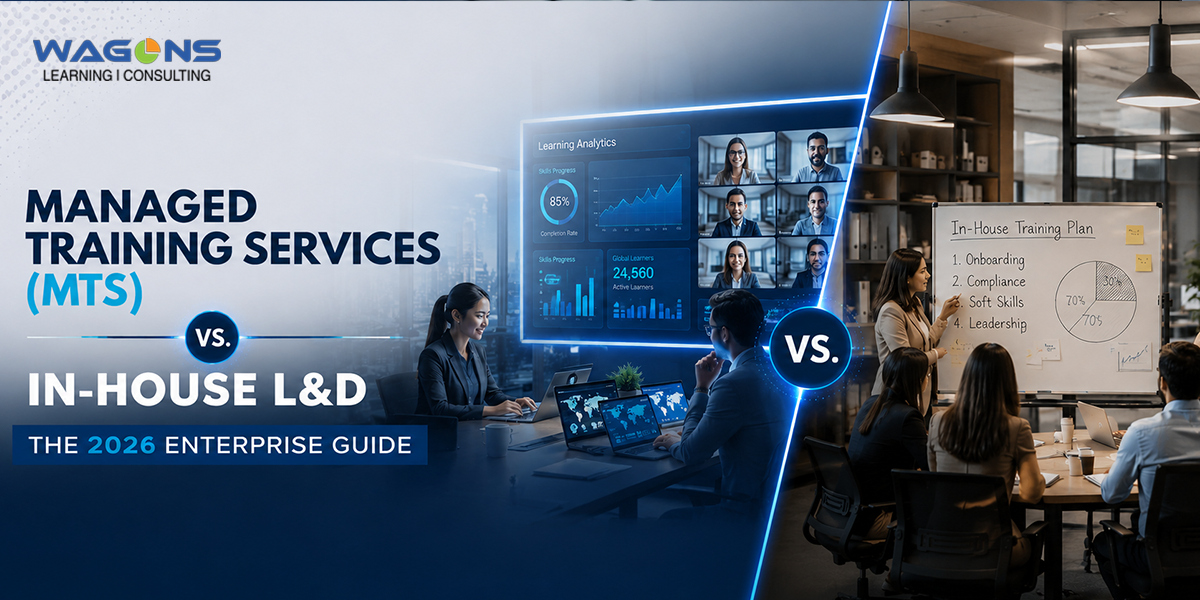
To reduce l&d costs rapidly without sacrificing workforce capability, enterprises are moving aggressively toward Managed Training Services (MTS). Wagons Learning serves as a comprehensive MTS partner, allowing large organizations to outsource the heavy, expensive infrastructure of corporate learning.
Instead of maintaining your own bloated ecosystem, Wagons Learning provides a unified, end-to-end solution. We deploy our proprietary Learning Management System, our own Skill Intelligence platform, and our dedicated teams of instructional designers. Because Wagons operates at a massive scale, we absorb the fixed costs of technology and administration. We then deliver targeted, high-impact training to your workforce as a lean, variable expense. This allows your internal HR leaders to stop managing software and start focusing entirely on strategic workforce alignment.
Financial Impact Table: Fixed In-House vs. Variable MTS
When L&D budget cuts 2026 mandates are issued, the difference between a legacy in-house setup and the Wagons MTS model becomes stark. The table below illustrates the direct financial impact of migrating your corporate training infrastructure.
| Financial Metric | Legacy In-House L&D Infrastructure | Wagons Managed Training Services (MTS) |
| Budget Structure | Fixed (CapEx). High baseline costs regardless of training volume. | Variable (OpEx). Costs scale strictly with organizational consumption. |
| Technology Expenses | High LMS cost of ownership, separate authoring tools, internal IT maintenance. | Zero tech bloat. Unified LMS and Skill Intelligence platform included in the MTS structure. |
| Vendor Management | High administrative cost managing 5+ fragmented software and content vendors. | Single-vendor consolidation resulting in streamlined billing and bulk efficiencies. |
| Payroll Overhead | Full-time salaries for instructional designers and admins, resulting in idle time waste. | On-demand access to specialized L&D professionals; you pay only for active project hours. |
| Overall Cost Per Learner | High and unpredictable due to hidden administrative hours and software integrations. | 20% to 30% reduction, offering a predictable, highly efficient average training cost per employee. |
Conclusion: Cut the Waste, Not the Future
Corporate l&d budget optimization is not about halting employee development; it is about eliminating the operational friction that makes training artificially expensive. In an economic downturn, large enterprises cannot afford to maintain a fragmented, high-fixed-cost L&D department.
The organizations that emerge stronger from the 2026 financial climate will be those that restructured their operations. By migrating to a Managed Training Services model, you strip away the administrative waste, secure your bottom line, and ensure your workforce remains sharp, compliant, and ready to execute.
Contact Wagons Learning today to transition your L&D department from a rigid cost center into a lean, variable, and high-performing business asset.