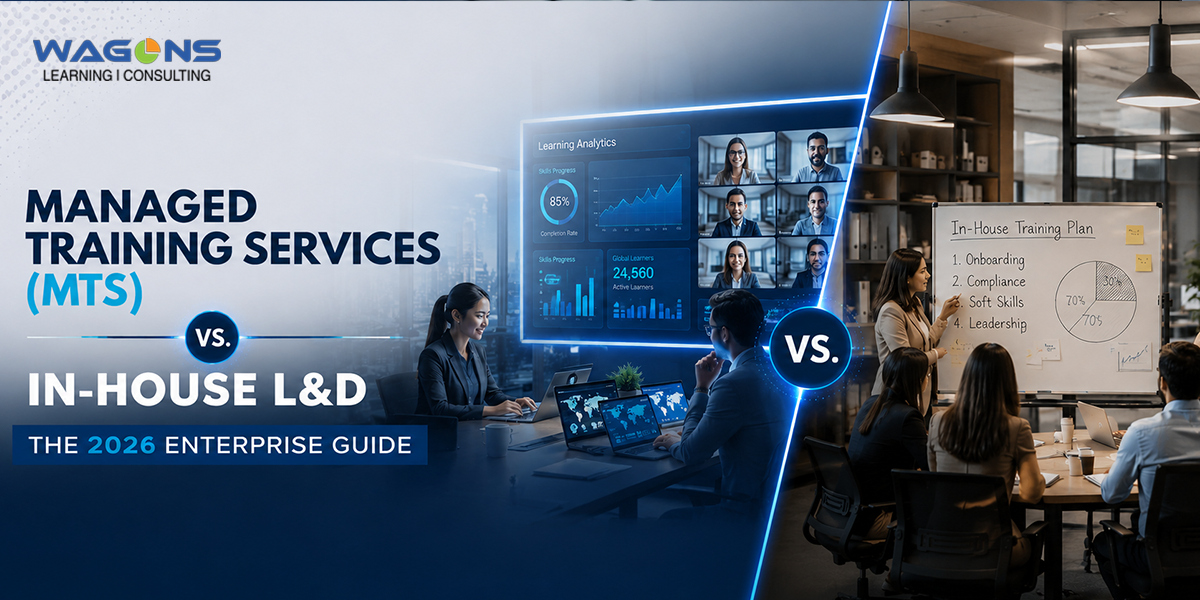
The debate between managed training services vs in-house l&d has reached a critical tipping point for organizations scaling past the 1,000-employee mark. What functions efficiently for a mid-sized company quickly becomes a financial and operational bottleneck at the enterprise level. In 2026, the speed of skill decay and the rapid implementation of new technologies require a learning infrastructure that is both agile and cost-effective.
Chief Learning Officers (CLOs) and Chief Financial Officers (CFOs) are realizing that maintaining a massive internal Learning and Development (L&D) department is no longer sustainable. Building and maintaining training internally creates a bloated fixed-cost structure. To achieve true scale, enterprises must critically evaluate how they deploy their L&D budgets and decide whether owning the infrastructure is holding back their operational performance.
The Iceberg Effect: Identifying the Hidden Costs of In-House Training
The hidden costs of in-house training are rarely reflected accurately in standard budget forecasts. When executives look at internal L&D, they often only see the direct payroll of their trainers and instructional designers. This creates a false assumption that internal training is the cheaper option.
In reality, maintaining an internal L&D department incurs heavy “Per-Employee Costs” that drain corporate budgets:
- LMS Administrative Overhead: Managing enterprise-grade learning software requires dedicated IT support, system administrators, and continuous integration efforts. Your L&D team ends up spending 60% of their time managing software updates and troubleshooting login issues rather than aligning skills with business goals.
- The Tech Stack Bloat: A modern training ecosystem requires a Learning Management System (LMS), authoring tools, skill assessment software, and analytics dashboards. Purchasing these standalone licenses for a 1,000+ workforce creates massive, compounding software expenses.
- Idle Payroll and Resource Inflexibility: Internal teams are fixed costs. During peak rollout periods (like a new compliance mandate), the internal team is overwhelmed. During slow periods, the organization pays full salaries for underutilized instructional designers and trainers.
- Content Decay: In-house teams often take three to six months to build a comprehensive curriculum. In fast-moving sectors like BFSI or Automotive, the market or regulatory environment often changes before the training is even deployed, rendering the investment obsolete.
Outsourcing Training and Development: Defining the MTS Model
Outsourcing training and development through a Managed Training Services (MTS) model is a fundamental shift in corporate strategy. It is not simply hiring external trainers for a one-off workshop. MTS is the comprehensive outsourcing of your entire L&D infrastructure—from skill gap analysis and content creation to software hosting and ROI reporting.
The core financial advantage of an MTS model is the transition of a fixed vs variable l&d budget. Instead of carrying the heavy CapEx (capital expenditure) of software and full-time salaries, enterprises shift to a scalable OpEx (operational expenditure) model. You pay for the capability and execution you need, exactly when you need it, without the administrative burden.
Stop Paying for L&D Administrative Bloat
Consolidate your software, content creation, and training delivery under one unified infrastructure. Partner with Wagons Learning to drastically reduce your Per-Employee Cost and align your L&D budget with actual business outcomes.
Scaling Corporate Training: A Strategic Comparison
Scaling corporate training effectively requires an objective look at how both models perform under enterprise conditions. The table below outlines the operational realities of both approaches for organizations with over 1,000 employees.
| Operational Metric | Traditional In-House L&D | Managed Training Services (MTS) |
| Financial Structure | High fixed costs (Salaries, multiple software licenses, IT support). | Variable, predictable costs aligned strictly with consumption and output. |
| Corporate L&D Outsourcing Cost | N/A (Internal costs often exceed projections due to hidden administrative hours). | 20% to 30% reduction in total “Per-Employee Cost” due to consolidated vendor management. |
| Speed to Deployment | Slow. Content creation is bottlenecked by the capacity of the internal design team. | Rapid. Access to a dedicated, scalable team of instructional designers and subject matter experts. |
| Technology Infrastructure | Fragmented. Requires integrating separate tools for delivery, authoring, and analytics. | Unified. MTS providers supply an integrated LMS and Skill Intelligence ecosystem. |
| Strategic Focus | Tactical. HR leaders spend their time managing vendor contracts and software glitches. | Strategic. HR leaders focus on succession planning, workforce mobility, and business alignment. |
Wagons Learning: Your Managed Learning Services Provider
Selecting the right managed learning services provider determines the success of this transition. Wagons Learning operates as a complete extension of your enterprise, providing the end-to-end infrastructure required to build a high-performance workforce.
We eliminate the friction of dealing with multiple vendors by providing a consolidated, high-ROI solution:
1. Unified Tech Infrastructure
Wagons eliminates your tech bloat. As part of our MTS offering, we deploy our proprietary Learning Management System (LMS) and Skill Intelligence platform. This provides your organization with automated skill mapping, personalized learning pathways, and data-driven talent mobility—all without the excessive licensing fees of standalone software.
2. Agile Custom Content Development
We recognize that generic content does not solve specific business problems. Wagons brings a dedicated team of instructional designers who build highly contextualized, industry-specific modules. Whether you require interactive AR scenarios for manufacturing or complex regulatory modules for banking, we develop and deploy content in weeks, not months.
3. End-to-End Execution and Accountability
Our MTS model assumes total responsibility for the learning lifecycle. We handle the skill gap analysis, coordinate the blended learning deployment (digital and VILT), manage all technical administration, and provide executive dashboards that directly link training completion to organizational key performance indicators (KPIs). Your HR team reclaims its time to focus on high-level strategy.
Conclusion: Restructure Your Enterprise L&D for 2026
Relying on an in-house L&D model for a large enterprise is an outdated approach that traps capital in administrative overhead. To remain competitive, organizations must prioritize execution and scalability over owning the process.
Migrating to a Managed Training Services model allows you to convert a bloated cost center into a lean, performance-driven asset. By partnering with Wagons Learning, we ensure that your workforce receives precise, high-quality training at a significantly lower Per-Employee Cost.
Contact Wagons Learning today to schedule a comprehensive audit of your current L&D expenditure and transition to a highly efficient Managed Training Services infrastructure.