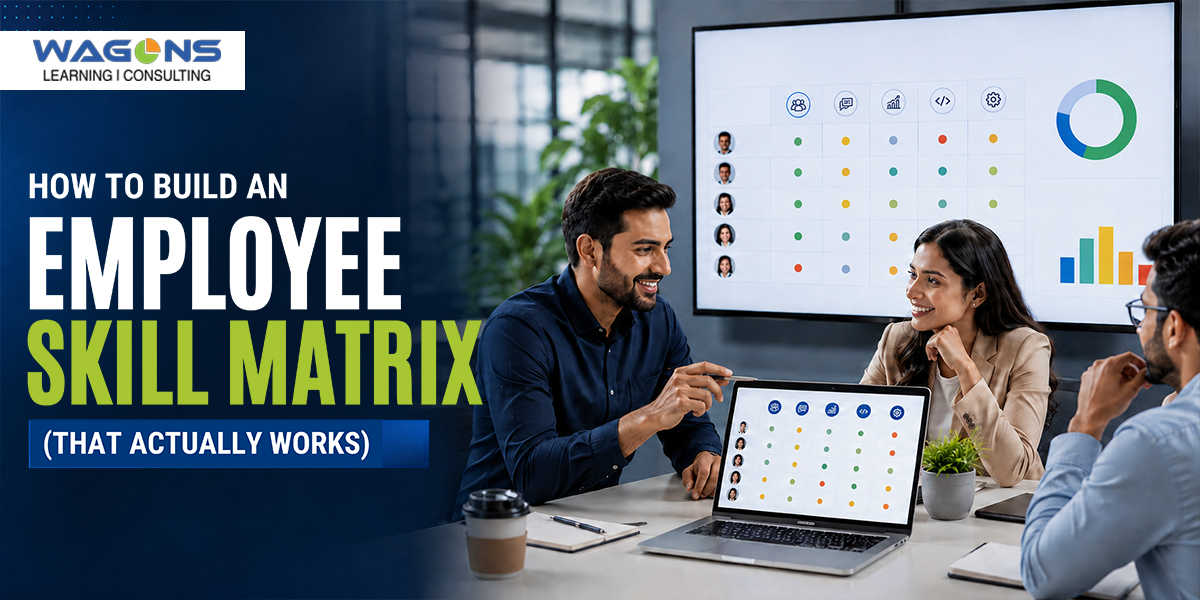
An employee skill matrix is theoretically the most powerful resource in a Chief Learning Officer’s operational toolkit. For enterprise organizations scaling past 1,000 employees, having a visual grid that maps current workforce capabilities against required business goals is essential for targeted upskilling, succession planning, and internal mobility. However, in 2026, the traditional execution of this tool is actively failing large organizations.
HR departments spend hundreds of hours manually compiling competency data, only to find that the matrix is operationally useless by the time it is published. To execute a workforce strategy that actually impacts the bottom line, organizations must stop treating capability tracking as a one-time administrative chore and start treating it as a dynamic, data-driven infrastructure.
The Excel Graveyard: Why the Traditional Skills Matrix Template Fails
A standard skills matrix template downloaded from the internet and managed in a spreadsheet simply cannot handle the complexities of a 2026 enterprise workforce. While an Excel sheet might work for a 50-person startup, applying it to a distributed, 1,000+ employee corporation creates immediate structural failures.
The traditional manual approach suffers from three fatal flaws:
- Static Data in a Dynamic Market: A manual matrix is outdated the moment you hit “save.” As employees complete new training, take on new projects, or as market technologies shift, the spreadsheet remains stagnant, leading to decisions based on obsolete data.
- The Bias of Self-Reporting: Most manual matrices rely heavily on self-assessments or subjective manager ratings. This lack of objective validation results in a highly skewed map where capability gaps are hidden by inflated self-scores, rendering any subsequent skill gap analysis highly inaccurate.
- Administrative Paralysis: The manpower required to constantly email managers, aggregate data, and reformat spreadsheets creates massive administrative overhead, driving up the per-employee cost of your HR operations without delivering strategic ROI.
4 Steps to Build a Data-Driven Employee Skill Matrix
To build an employee skill matrix that drives actual business performance, enterprise leaders must transition from manual spreadsheets to a systematized, objective framework.
1. Standardize Role-Specific Competencies
Before mapping individuals, you must define the exact requirements of every role using global benchmarks. Relying on outdated internal job descriptions is a risk. Map your organizational roles against standardized frameworks like SFIA (Skills Framework for the Information Age) or O*NET. This ensures that the skills you are tracking are calibrated to current global industry standards.
2. Implement Objective Skill Assessments
A reliable matrix requires hard data, not opinions. Move away from basic 1-to-5 manager rating scales. Implement a multi-source validation process that includes structured technical assessments, scenario-based evaluations, and peer feedback. This provides a measurable baseline of true proficiency rather than perceived competence.
3. Automate the Data Aggregation
For 1,000+ employees, manual data entry is a guaranteed point of failure. The matrix must live within a dynamic software ecosystem that automatically updates an employee’s profile the moment they complete a certification, finish a training module, or execute a new project.
4. Connect the Matrix to Actionable Deployment
A matrix is useless if it only serves as a reporting tool. The data must directly trigger automated learning pathways. If the matrix identifies a critical gap in a specific department, the system must immediately assign targeted upskilling modules to close that exact gap, rather than forcing employees through generic training programs.
Stop Managing Spreadsheets and Start Managing Capability
Manual skill mapping drains your HR budget and produces outdated data. Partner with Wagons Learning to deploy an automated, AI-driven Skill Intelligence platform that maps, tracks, and upgrades your workforce in real-time.
Moving Beyond Excel: The Role of a Skill Intelligence Platform
A skill intelligence platform is the modern evolution of the employee skill matrix. At Wagons Learning, we recognize that enterprise clients cannot scale their operations using fragmented manual processes. We have engineered our proprietary Learning Management System (LMS) to function as a living, breathing capability map.
When you deploy Wagons’ Skill Intelligence, you replace the static spreadsheet with a dynamic infrastructure:
- Real-Time Visibility: The Wagons platform provides live dashboards showing the exact proficiency levels of your entire workforce, allowing CFOs and CLOs to see exactly where their capability risks lie at any given second.
- Internal Talent Mobility: Instead of paying high recruitment costs to hire externally, the platform uses your dynamic skill matrix to instantly identify internal employees who already possess the required skills for new projects or leadership roles.
- Targeted Upskilling ROI: Because the system accurately identifies precise skill gaps, it only deploys training where it is strictly necessary. This eliminates wasted hours spent on redundant courses and maximizes the financial return on your L&D budget.
Strategic Comparison: Manual Matrix vs. Wagons Skill Intelligence
Evaluating the true cost and effectiveness of your current capability mapping requires a direct comparison. The table below illustrates the operational differences between a legacy spreadsheet approach and the Wagons automated infrastructure.
| Capability Metric | Manual Skills Matrix Template (Excel) | Wagons Skill Intelligence Platform |
| Data Accuracy | Low. Relies heavily on subjective manager opinions and delayed self-reporting. | High. Multi-source validation using assessments and real-time LMS data integration. |
| Update Frequency | Annually or Bi-annually. Data is obsolete between review cycles. | Continuous. Profiles update automatically upon course completion or project execution. |
| Scalability (1,000+ Staff) | Breaks down entirely; requires massive administrative HR hours to maintain. | Seamless. Handles tens of thousands of users simultaneously with zero added admin overhead. |
| Actionability | Requires manual review to assign training or identify candidates for internal roles. | Automated. Instantly triggers personalized learning pathways and matches internal talent to open roles. |
Conclusion: Automate Your Workforce Capability
Building an employee skill matrix is non-negotiable for enterprise survival, but managing it manually is a strategic error. In a rapidly shifting B2B landscape, you cannot afford to base your workforce planning on outdated spreadsheets and subjective guesses.
To build a high-performance organization, you need immediate, accurate visibility into exactly what your workforce can do today, and what they need to learn for tomorrow. Transition away from administrative bloat and upgrade to a system that turns capability tracking into a competitive advantage.
Contact Wagons Learning today to integrate our Skill Intelligence platform and transform your static skill matrix into a dynamic engine for enterprise growth.