Measuring training ROI is the definitive metric that separates successful Chief Learning Officers (CLOs) from those whose budgets are cut by the board. In 2026, presenting a Chief Financial Officer (CFO) with a report highlighting “95% course completion rates” or positive post-training “smile sheets” is a massive strategic error. Executive boards do not fund learning for the sake of learning; they fund business capability.
For enterprise organizations scaling past 1,000 employees, the era of vanity metrics is over. L&D departments must operate as revenue drivers and cost-reduction centers. Proving this requires drawing a direct, indisputable line between the hours an employee spends in a training module and the subsequent improvement in a specific business Key Performance Indicator (KPI).
Evaluating Training Effectiveness: The Data Silo Problem
Evaluating training effectiveness accurately is nearly impossible for most in-house L&D teams because of structural data silos. In a standard corporate setup, learning data (who took what course and their quiz scores) lives inside an isolated Learning Management System (LMS). Meanwhile, actual performance data lives in entirely different systems—sales numbers in a CRM, error rates in an ERP, or turnover rates in an HRIS.
When L&D teams attempt to measure ROI, they are forced to manually export spreadsheets from these disconnected systems and attempt to correlate the data. This manual approach is fundamentally flawed:
- Lagging Indicators: By the time the data is merged and analyzed, the reporting period is over, making it impossible to adjust the training in real-time.
- Correlation vs. Causation: Without precise tracking, L&D cannot definitively prove that the training caused the performance increase, allowing other departments to claim the credit.
- Administrative Drain: The hours spent wrestling with spreadsheets drive up the overall cost of the L&D department, further diminishing the actual ROI of the training initiative.
How to Calculate ROI of Training: The 2026 Business-First Framework
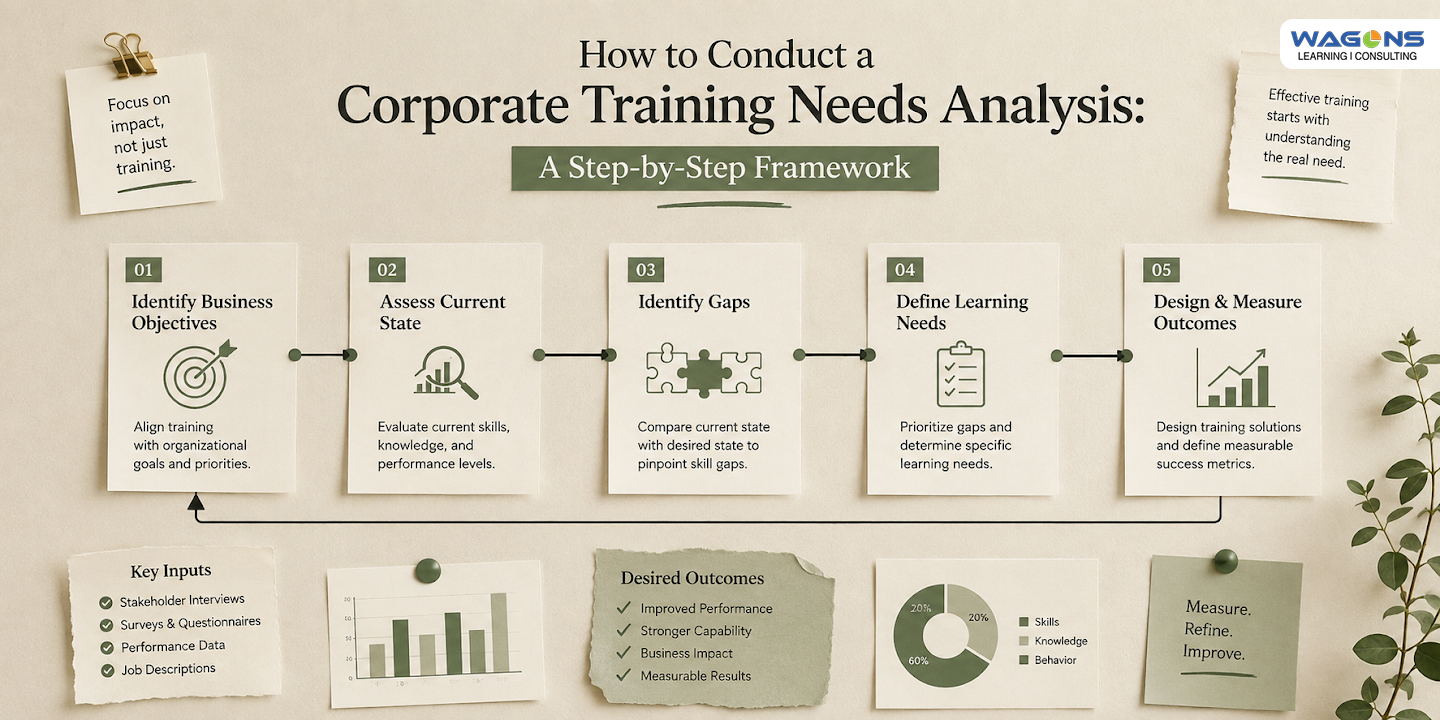
How to calculate ROI of training in a modern enterprise requires abandoning traditional academic models and adopting a strict, business-first framework. You cannot measure financial return if you start the process by looking at the training content. You must reverse-engineer the process starting from the balance sheet.
Here is the three-step framework for 2026:
1. Isolate the Target Business KPI
Before any content is drafted, the L&D team and the business unit leader must agree on a single, measurable KPI. If the sales team is missing targets, the KPI is not “improve negotiation skills.” The KPI is “increase the lead-to-close ratio by 12% within Q3.”
2. Map the Specific Capability Gap
Once the KPI is locked, use objective data to identify the exact behavioral gap causing the failure. Do not assign a generic 10-hour sales course. If data shows reps are losing deals specifically during the pricing discussion, the training must be a hyper-targeted micro-module on pricing objection handling.
3. Monetize the Behavioral Impact
To determine the financial return, convert the post-training behavioral change into exact currency. If the targeted training reduces customer support call handle times by an average of 45 seconds, multiply that time saved by the hourly rate of the support agents, multiplied by the total call volume. The resulting dollar amount is your hard ROI.
Stop Guessing the Value of Your Corporate Training
Eliminate manual spreadsheets and vanity metrics. Partner with Wagons Learning to deploy an L&D infrastructure that natively tracks and proves its own financial impact in real-time.
ROI of Training and Development: The Shift to Automated Skill Intelligence
The ROI of training and development cannot be measured manually at an enterprise scale. To prove value consistently, organizations are abandoning fragmented in-house systems and migrating to Managed Training Services (MTS) equipped with advanced Skill Intelligence platforms.
At Wagons Learning, our infrastructure is built specifically to solve the data silo problem. We provide an integrated ecosystem where learning delivery and capability tracking occur in the same environment. Our Skill Intelligence platform maps the precise skills your employees acquire and correlates them instantly with role-specific benchmarks. Instead of waiting for a quarterly review, executives have access to live dashboards that display exact capability gains. By automating the tracking process, we remove the administrative burden and provide undeniable proof of L&D’s financial contribution.
Training Metrics 2026: Traditional Evaluation vs. Wagons Automated ROI
Training metrics 2026 demand a transition from subjective surveys to hard financial data. The table below illustrates the operational differences between legacy evaluation methods and the Wagons Skill Intelligence approach.
| Evaluation Metric | Legacy L&D Tracking | Wagons Skill Intelligence & MTS |
| Primary Focus | Course completion rates, total training hours, and user satisfaction scores. | Direct impact on business KPIs (e.g., reduced error rates, increased sales velocity). |
| Data Integration | Siloed. Manual exporting and merging of LMS and CRM spreadsheets. | Automated. Skill intelligence correlates capability gains natively within the platform. |
| Reporting Speed | Lagging. Reports generated weeks or months after training completion. | Real-time. Live executive dashboards tracking capability shifts as they happen. |
| Financial Output | Vague estimates of “improved productivity.” | Hard monetization formulas demonstrating exact capital saved or generated. |
Conclusion: Turn L&D into a Revenue Engine
Proving the financial value of corporate training is no longer an optional end-of-year exercise; it is the core requirement for sustaining enterprise L&D. If your organization relies on disjointed systems and manual spreadsheets, you are operating with massive blind spots.
To secure your workforce strategy in 2026, you must align your training infrastructure with strict business outcomes. Partner with Wagons Learning to transition from tracking vanity metrics to deploying a data-driven Managed Training Service. Equip your enterprise with the tools required to measure true capability, prove definitive financial return, and transform your L&D department into a measurable revenue engine.